Showing posts with label Cooking. Show all posts

Grilled Cheese: The Great Neutralizer of Cheese Warfare

Nobody likes a cheese snob. Nobody likes a food snob of any kind really, but a cheese snob might be the most heinous. Unlike, say, wine or a perfectly cooked scallop, cheese is a link to our childhood; the familiar comfort food without class boundaries. To engage in cheese snobbery is an affront to everyone's warm nostalgic cocoon of plebeian culinary memories. It is to say our shared history of sandwich slice American Muenster is garbage because not everyone knows that real Munster cheese is German, soft, virtually unsliceable, and stinky. It is to say your childhood joy for baseball park nachos is inferior to my piece of AOC-protected village-made raw milk Camembert. And that's just mean.
The Cuban Grilled Cheese with plantains
Expanding cheese knowledge and eating right is important, but not at the cost of being a butthead. No cheese food has taught me this lesson more explicitly than the Grilled Cheese. 

I've had my share of grilled cheese experimentation, and the one thing I love about this cheese vehicle is its versatility in conveying each individual's flavor preferences, be they lofty or pedestrian. There are a few universal cross-cultural truths to a good grilled cheese. 
1) The correct skillet or grill heat to achieve a crisp, golden brown (but not burnt) bread and crust
2) Appropriately melted and gooey cheese 
3) Appropriate ingredient ratios to avoid the dreaded sogginess

Beyond that, there are no cheese grilling laws. 

I love that grilled cheese can be a vehicle for almost any culture's street food flavors. Recently, I had a Cuban grilled cheese with Cheddar, Swiss and fried plantains. Similarly, I imagine a Haloumi and eggplant grilled cheese would be delicious if the appropriate limits to ingredient heft are maintained. The list is endless--even for cultures that don't have a cheese tradition. Throw some teriyaki chicken between some melty cheese slices before convincing yourself it's not good without trying it first. 

Sure, there are plenty of delicious ways to snob-up a grilled cheese. Pardon me lad, this poached pear on my grilled brie sandwich is far too crisp. Righto, but I said I did want onion confit on my grilled gruyere. By jove, there's no truffle oil on this?! (I don't know why my grilled cheese snobs sound British in my head.). Point being, a fancy pretentious grilled cheese with the right balance is also delicious...as long as you're not a jerk about it. 

I love the balance of salty and sweet, so if left to my own devices I add some homemade honey butter to the grill side of my bread, which is stuffed to the brim with sharp cheddar. Sometimes jam is also a welcome addition to the interior ingredients. 

Creativity is encouraged. At a late-night grilled cheese parlor in West Texas, I was introduced to an ingredient that has found a home in my grilled cheese options: the Ruffles potato chip. Hello extra crunch. Cheese it up to the maximum and throw some Cheetos in there. Do it in moderation and on occasion only, lest the crunch also finds a home in your arteries. 

My one pitfall into snobbery arises with American Cheese. American Cheese Singles freak me out, even though I've hypocritically avowed to (in moderation) graciously partake of your Superbowl Velveeta and Rotel or take a hit of your Easy Cheese on a Ritz Cracker for the sake of politeness and/or nostalgia. The Grilled Cheese, however, works its humbling powers on me. Though I prefer a sharp high-quality yellow cheddar to a Kraft Single, I'll appreciate the ooze-to-melty-stretch beauty of a good American Grilled Cheese. I'll probably even class it up by shoving some potato chips in there. 

Movin On Up to the Cheese Pie

Half the week I'm stirrin' up some curds and haulin' large wheels with some great cheesemakers in Waco. The other half, I'm playing a proper 1950s housewife back in Del Rio. I make pies. Many pies.

It all started three months ago with one of my favorites, southern lemon chess pie. The chess pie was my first ever pie and pie crust attempt; it met rave reviews and is likely the main reason my boyfriend put plans in motion to propose marriage. The obsession progressed to the point where I was making three pies in one day.

Cheese is no stranger to pies. So, eventually, I decided to set up a play date for my good friends cheese and pie.

You've heard of cheesy desserts incorporating smooth, sweet cheeses like cream cheese (cheesecake) or mascarpone (tiramisu). Stronger cheeses can also participate in the dessert party as a standalone treat (cheese plate, or see blue cheese-honey-Sauternes combo from my Valentine's Day post). But I'm a believer that non-traditional cheese desserts have a place in the sugary pantheon as well. Enter pies.

Remember that ricotta I made in the last post? It would meet its sweet fate in my first cheese-based pie attempt, a "Cheese and Honey" pie.

Stumbling through several online recipes, I discovered that the so-called "cheese and honey" title that initially caught my eye was actually a traditional Greek dessert called Melopita. Generally the pie is made with either Ricotta or Myzithra cheeses. Myzithra (also Mizithra) is a Greek cheese made from whey remaining from feta production and a bit of added goat or sheep milk. The cheese is then pressed and salted, so it resembles Ricotta Salata in texture and taste. Myzithra would have been the more exotic and daring choice, but my castaway ricotta from my mozzarella debacle needed a home.

Because whey ricotta is a by-product of an initial cheese-make, it's a fairly low-yield cheese. I needed 16 ounces total, so I had to combine my small ricotta ball with some whole milk ricotta I purchased at the store. Because whey is high in protein and low in fat, my ricotta was the healthier of the two. Whole milk ricotta is made entirely or partially from the actual milk. The milk is curdled by vinegar in a manner similar to paneer, so the finished product still has all of the fat and cream from the original milk.

Melopita dusted with cinnamon
The pie was fairly simple: mix ricotta, 4 eggs, 1/2 cup honey, 2 tablespoons flour together for the filling. I then added cinnamon, vanilla, and a bit more honey according to my own taste. I also boozed up my basic crust recipe with some bourbon and vanilla. My final result tasted like a fantastic pumpkin pie. It was creamier in taste and a bit thicker in texture, but very reminiscent of fall.

The first Melopita recipe I found called for either ricotta or "other curd cheese." Translated, the vaguely stated instructions simply direct you to either ricotta or cottage cheese. In the comments one hapless woman, confused by the term "curd cheese," decided to use cheddar curds she had laying around. Fortunately, she said her pie turned out fantastic. While that's not what the Greeks had in mind, I'm just crazy enough to be intrigued by the blundering variation. If I can get my hands on some cheddar curds (not in Del Rio), I might just experiment with such pie insanity.

For now, I'll just tell you about the other, far more "traditional" (so-to-speak) cheddar and pie experiment to which I progressed. A surprisingly sizeable portion of the U.S. population has likely heard of apple pie being served with cheese melted on top or on the side as curds or chunks. I believe it's fairly popular in New York and other Northeastern states. The rest of you probably just threw up in your mouth a little. You have no reason to trust me. I'm the type of person who likes weird food combinations like ice cream and cheese sandwiches when I was a kid or Funyons with a Fig Newton when I was ...bored.  But believe me, you haven't lived until you've eaten apple pie with cheese.

I'd seen the combination on menus before and in a scene of Taxi Driver where Robert DeNiro's character orders apple pie with cheese. But I wanted to try to make cheese get cozier with the pie. I wanted to add the cheese directly to the pie as it appeared in many recipes for Yorkshire apple and cheese pies. In fact, our pie-with-a-side-of-cheese tradition was likely brought over to the colonies from English and Scottish settlers.

I found the best white cheddar Del Rio had to offer (some $10/lb blocks from a random New York cheesemaking factory I'd never heard of), and let my madness unleash itself. I found four or five recipes to start from, mixed and matched, and ended up with two experiments.

This unassuming crust holds
a delightful hidden ingredient
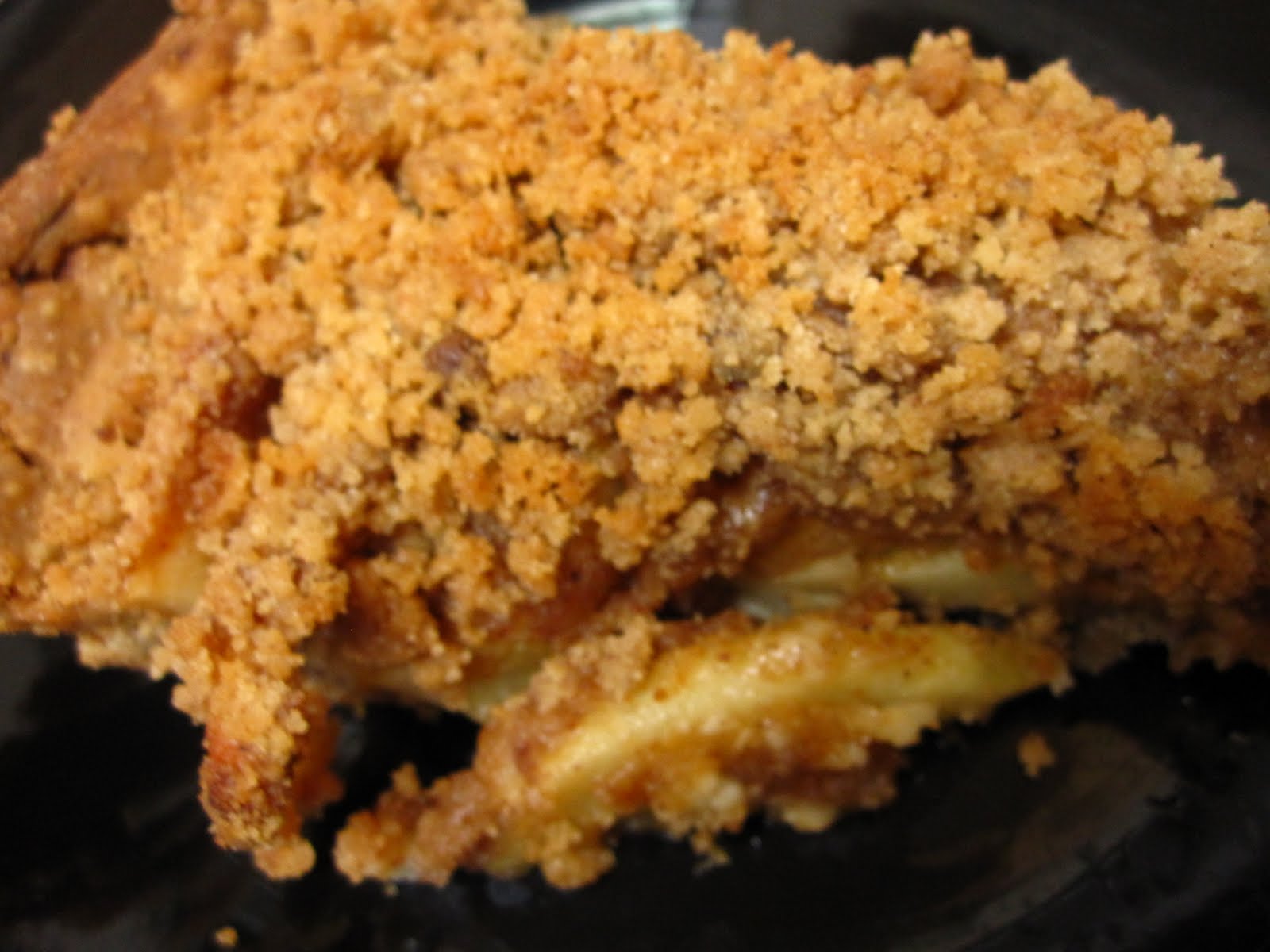
One was a streusel pie with the cheese in the filling: standard crust, sliced apples tossed with 1/2 lb of shredded cheddar and the other filling accouterments (cinnamon, nutmeg, lemon juice, corn starch, brown sugar, vanilla, and yes, bourbon), and a sugar-flour-butter streusel topping.

The second pie incorporated cheese into the crust instead of the filling. So I made the same filling, minus the cheddar. Then I folded a 1/2 lb of shredded cheddar into the crust instead. The dough tasted like a cheddar biscuit. It was so good I started to eat raw dough with glazed, crazed delight in my eye. Feeling ill, I returned to pie-making.

I lined the pan with the cheese crust, added the filling and covered the top with the cheddar crust as well (no streusel). Then, I made a maple-*ahem*bourbon sauce to be added to either pie. In the end, neither pie needed the sauce, so I just used it as ice cream topping. The pies were amazing standing alone. The classic combination of sweet fruit with salty cheese. Incorporating the cheddar into the recipe made for a cohesive and subtle cheese flavor. I imagine that taking bites of curd alongside pie would pack a stronger punch.

I'm obsessed, so I could have actually used a bit more cheese flavor in my pie. Next time I might try a pie with cheddar in the crust AND the filling. Convention and moderation can't hold me down.


I was too excited to eat these pies in immediate succession to make time to focus my camera

When Keepin it Real Goes Right

It is no secret that I've become quite accomplished at making unmeltable cheese in my kitchen. Last week, I gave my next home cheesemaking move some thought. Suddenly, I realized perhaps this was all a sign from celestial cheese spirits to start with my roots in making South Asia's signature and stalwartly unmeltable cheese:  Paneer.

Paneer is an Indian cheese used in many curries, acting essentially as a cheese tofu because it doesn't melt. It adds texture to soupy vegetable-based dishes, but flavor is not its main purpose. For that reason -- and because it's so easy to make -- Paneer is usually a homemade cheese and not a mass or artisanally produced one.

My paneer in all its glory
Paneer is an Indian cheese. I'm Indian. Paneer doesn't melt. I'm really good at making cheese that doesn't melt. Someone wrap a bow on this perfect plan, I thought.

My curry of choice for the finished cheese would be Palak Paneer, a pureed spinach dish.  Indian food, much less the ingredients to make said Indian food, are completely non-existent here in Del Rio. After all, I am the South Asian community in town...and most people here just assume I'm Mexican anyway -- which really takes the fun out of the "guess my ethnicity" game we brown people love to play. Palak Paneer would be a rare curry for which I could find all the ingredients in Del Rio. It would also serve the dual purpose of being a delightfully green celebration of St. Patrick's Day. I'm nothing if not multi-cultural.

The milk begins to curdle in the boiling
foam instantly after adding the acid
Several variations for paneer recipes exist, but the basic idea is the same. Boil the milk, and just before it starts to foam over the pot, add an acid that will curdle (a.k.a. coagulate) the milk. Typically, I've mentioned cheeses that use a combination of culture and rennet to acidify and then curdle the milk. However, high acid levels, such as when milk is left out to sour, will naturally curdle the milk over time. Really high acid levels will wad-up the protein even more quickly and without the need for rennet. So, the addition of something like vinegar or lemon juice will get you instant flavorless curds.

The fluffy curd is finished when it has
completely separated, leaving behind
only clear whey
I started with two quarts of milk and opted to use citric acid powder because I had it on hand with my cheesemaking supplies. I have only used the citric acid once in a quick and easy mozzarella recipe made without cultures, so I had no idea how its potency compared with basic lemon juice. Either I didn't dissolve the citric acid  in water properly or I used too much, but I didn't care for the consistency of the curd it produced. The curd was rough, dry, fractured and formed too quickly. The key to making Paneer is adding the acid slowly in increments as the curd begins to puff up like clouds in the foamy pot. I ditched my first attempt and started over with lemon juice.

Lemon juice & pure
citric acid
Again, I started with two quarts of milk. A split second after the foam started to rise over the pot, I frantically added lemon juice concentrate. (I recommend using a deep pot.). Before starting, I had poured about four tablespoons of juice in a glass. As I slowly poured from the glass, the milk that hadn't spilled over into the burner started to form tufts and calmed the bubbling milk. I added a little at a time until the puffy white curds separated completely from the clear yellow whey. By the time the whey was completely clear, I had probably used only about a tablespoon or two of the lemon juice in the glass. And I had a fluffy, moist, thicker curd.

My pressing rig
The two quarts didn't produce quite enough curd, so I repeated the steps with a second batch. I pressed the two batches with various heavy jugs in cheese cloth-lined net to drain some whey. Finally, I had the the desired curd to mold into a block. The finished cheese was about two inches thick after pressing and then molding it into a small tupperware container. One variation I found on the recipe that I may try next time is adding about half a cup of yogurt to the milk. My guess is that the extra ingredient would produce a better texture.

The next day, I cut the cold paneer into cubes resembling tofu, and added it during the final stages of cooking the spinach curry. Paneer disappears into the green soupiness, softening but never melting, and surprising you with a chewy morsel in random bites of delicious curry.

Come join me for an Indian feast
on St. Patrick's Day!
Despite my ancestry, I've never commanded any legitimate respect when it comes to cooking Indian food. The recipes my mother gives me never turn out quite as authentic when I make them. Yet, I think I made the motherland proud with the Indian dinner I had concocted:  Palak Paneer with my homemade paneer; mango lassi, a mango yogurt drink made with my homemade yogurt; and baked chicken with tandoori spices. Everything, especially the cheese, looked and tasted perfect. Oh those wily cheese spirits, always know exactly how to get you out of a rut.