Showing posts with label Daily Tasks. Show all posts

Earning My Cheese Cred

So you know that formula in movies, particularly sports movies, when the weak kid who the audience is really rooting for makes some awesome play to win the respect of the team and fans? "Nice work, kid," his teammates might casually say while giving him a playful head rub. The audience wipes away a single tear.

Well that happened to me in real life on Valentine's Day. Except nobody called me kid, nor did they rub my head. I was the only one crying, on the inside at least. Oh, and I wasn't in a movie or playing a sport. I was selling cheese.

Oh hello, my nemesis.
I am the weakest link in the machine-like cog that is the new cheese shop where I work. I am the new kid amongst knowledgeable cheese mongers who know the most delicate flavor profiles of cheeses from every which region of Europe and can cut through GIANT 40-lb wheels of rock-hard 2-year-old Gouda like it was butter. Until February 14, I had eased into my new job by working mostly weekdays and only one moderately busy, but very well-staffed, weekend day.

The rest of my two week introduction involved slowly getting to know the inventory of cheese and methodically and repeatedly wrapping cheese. I had figured out the characteristics of maybe 1/4 of the almost 200 cheeses. The fine art of wrapping the cheeses was a bit more elusive. The minutes accumulated as I fumbled to find the exact right way to make the plastic wrap practically invisible and glass-like on the surface of every oddly shaped piece. I would often re-wrap the same piece five times until I could get rid of the dreaded air pockets that can cause cheese to deteriorate. This was all good and fine on a slow day. On a busy day, our counter space is valuable. It's a tight squeeze behind the counter and quickly wrapping cheeses to go back in the case is the only way to service a hoard of hungry cheese freaks.

I'll admit my first few days, I felt like an idiot. It became immediately obvious how little I had learned about the vast world of retail cheese in the year-plus I had been working in this field. Sure, maybe I had a leg up on the average new trainee, but I felt like a lowly noob, continually asking my colleagues what cheeses to direct customers towards. Slowly I began to feel a little more comfortable with the case (or could at least guess based on the look of a cheese) and figuring out what the customer needed. I was getting better at wrapping cheeses for the case if I didn't have anyone anxiously waiting for my help. Plus, when nobody was watching I could hack off a workable piece of extra aged gouda from a giant wheel.

So when I showed up for work that Tuesday, I expected another slow easy transition into the expert cheese world. I was SOOO wrong. We were staffed for a regular weekday, and nobody saw the retail slam that was about to hit our doors. From 4pm until we closed at 9pm, nobody had a chance to eat or breathe. There was a lull for three minutes exactly, at which point I shoved a Fiber One bar down my throat. The line never ended. People wanted meats and cheeses and pairing suggestions for their loved ones and the crowded store and frantic cheesemongers were not deterring them. It didn't stop. It's 8:30pm! Shouldn't you be on your date already?!

And there I was, the lone new kid working with three dudes who REALLY know their cheese, their knife skills, and how to wrap and restock quickly to keep our cramped quarters clean. Then it happened. A customer points behind me to the giant bright orange wheel of rock hard gouda. I mentally crossed my fingers as I followed the trajectory of their gaze, hoping they were pointing to something else -- the baguettes maybe? Those are easy. Wrong.

In the middle of a crowded store, standing on a milk crate for leverage, I had to steady a giant knife through a nearly impenetrable wax rind because some fool only wanted a quarter pound of this giant wheel. It's not easy for these weak hands to steady a shaky blade and cut a razor thin slice off this behemoth. But everyone else handles the task with such apparent ease, and I'm going to have figure it out sooner or later.  It was ugly, but I did it without the luxury of assistance or moral support because everyone else was swamped. I wrapped up the giant wheel, restocked, cleaned some knives, and worked through the rest of the customers, person-by-person, keeping pace with my colleagues in trying to get everyone in and out quickly. Eventually, the store cleared out and most of the customers left seemingly happy.

At the end of the night, my co-workers applauded my work. I'm sure when the line started to back up on our understaffed cheese counter they were prepared for a worst case scenario of the new kid bringing the store to a crippling halt through nervousness and ineptitude. Granted, I did have some of that, but at least I managed to avert disaster instead of creating it. That was the day that I finally felt like I'd at least be okay at this.

There are still days that I come home feeling like a loser, brooding about that piece of cheese that fell apart because of one errant knife move or the piece that took me ten minutes to wrap. It will take me a while until I reach their level.  But at least the team can count on me in a moment of crisis.

The Grand Opening Report

I know I've been a bit derelict in my posting duties. The weeks since store opening have been action-packed. But I'm going to try my best not to leave Cheesy Street to the wayside going forward.

BOOM, Food Safety Certified, Blouses!
Ok, so it's not a picture of the store.  But I had
to take a test to get this card! And for now,
 it's the best I can do on pictures. 
Three weeks in and being an official cheesemonger and manager-on-duty at a giant cheese store feels like second nature. That didn't take long. Beecher's is huge, and we do a lot. We have a cafe area, an evening lounge/restaurant area downstairs, a charcuterie case, a coffee bar, a cheesemaking facility...a petting zoo. It's a carnival of cheese and cheese-related fun.  Not only did I need to quickly learn the cheese case, but I also needed to know the ins and outs of the cafe area, the charcuterie case and meat slicer (love cured meat but I know nothing about it), the espresso machine (which freaked me out at first), and various miscellaneous tasks that arise like receiving orders, building sandwiches and cheese plates, and answering customer questions that baffle me.

The first day was a non-stop explosion of customers and curiosity. I ended up working an opening to closing shift. Fifteen hours, and a I loved every second. My feet, not so much. Since then, things have been a steady but sane flow of people.

I know names, locations and stories of domestic cheese and cheesemakers pretty well. Yet, I've never had the opportunity to try many cheeses. So describing the flavor of each cheese is a completely different matter. That included most of the cheese in our case when we first opened. I felt pretty confident about being able to direct people to the right cheese. But the first couple of days was a lot of looking at cheeses and guessing what they would taste like and hoping for the best.
"Do you have anything similar to a manchego?"
(To my self) "Gah, I have no idea."
Scanning labels frantically; finding one with a picture of a sheep.
(To myself) "Mmmeh, this one looks like a semi-firm sheep's milk cheese. I bet it'll work."
"Yes we do actually. Here try this one. I think it comes pretty close."
Nom, nom, nom.
"Man alive, this is delicious! I'll take a slice."

I would try the cheese with the customer or after they left and discovered that my guesses were usually pretty accurate. Not always, but surprisingly often. It worked well. I guess lawyering taught me a thing or two about making things up on the fly.

It only took a few days of tasting and exploring along with the customers before I learned 90% of the cheeses in our case and didn't have to rely as much on panicked assumptions. Now, I can look at a wheel of cheese and know which cheese it is without seeing the label.  Plus it didn't take long to know the cheeses that are crowd pleasers and the ones that aren't.

In a nutshell, I love my job. I love conversations with random excited customers and regulars. People in NYC love cheese. I knew that from my farmers market days. But now I can explore up to 100 different cheeses with them and figure out which is the perfect cheese for each person, and this may sound strange, but that is inexplicably fulfilling. And if my brain is ever fried from figuring out which cheese hits the mark for every single person, I can always escape to the solitary, focused zen world of the espresso machine or sandwich press. Waking up for an opening shift at 5:00am can be difficult, not to mention the alarming introduction to an early morning/late night cast of characters on the subway. Once I'm at work it flies by and I love being there.

One of the best aspects of the job is continually trying, discovering and re-discovering new cheeses I love ...or even ones that I don't love so much. As I keep going, I'll try to share as many as I can with you. Just because not all of you can come into the store and find out directly from our cheese counter, doesn't mean you should be sheltered from new and delicious cheese discoveries.

On To The Next

After logging almost 11,000 miles of commute, plus one windshield replacement from an errant flying boulder on highway 90, two late-night near deer-to-hood encounters, several incidents of suppressed road rage, countless rendezvous with swerving semis, too many protein-bar-dinners on the road, and five or six gas-price hikes later, I bid adieu to another chapter in my cheese life. My last week at Waco's Brazos Valley Cheese was bittersweet. I wouldn't have made that trek if I didn't also really enjoy the people and the job that awaited me at the end. At the same time, there sure as hell will be no love lost between me and that 5pm to 11pm drive home to Del Rio every week.

Making the commute for almost five months is respectable, right? A part of me felt like a punk bitch when I had to explain that I would be leaving something I love because the drive had gotten too hard. It's not you, it's me. Never mind the emboldened sense of achievement I had each time someone questioned my sanity for making that commute in the first place. Anything for you, cheese.

It was time, though. Deep down I knew when I started that I couldn't make that commute forever. Hopefully I can parlay everything I learned with BVC and all my other cheese teachers in the last year (a little over a year to this day that I started this journey) to an equally wonderful and fortunate next chapter.

The next move will likely involve continuing to improve my home cheesemaking (and pies) while resuming my nomadic ways. Del Rio has few cheese ties to keep me here for long, so I'm following leads for the next opportunity elsewhere. At some point, Tad and I will be in the same city for more than a few months, and I'll finally be able to figure out what CheesyStreet actually is or will be. For now and the near future, I'm still living out of suitcases.

But before I move on, a tribute to the job that gave me my cheese swagger.

Big vat, dutch press in the background,
and my mini vat in the left foreground.
I've mentioned that my job at BVC made me feel more like a real cheesemaker. I started to list "cheesemaker" without hesitation in the occupation blanks for profile data, surveys, and doctors' office forms. The good people at BVC gave me more responsibility than I expected for having only six months of legitimate cheese experience. Are you sure you want to put me in charge of my own batch, I kept thinking? It seemed hasty, but I was thankful they unintentionally pushed me further. I hope I didn't let them down.

I've mentioned a few notable events at BVC, but I haven't gone into great detail about my daily tasks. The reasons are several-fold. First, a lot of the basics would be repetitive with slight variations in procedural technique. Too many details would have been a lot like listing the different varieties of high-fiber cereal I've eaten this month. Second, my new hobby of home cheesemaking and related mishaps became a big part of my cheese life in Del Rio and needed some introduction to the spotlight. But, most importantly, there was no true schedule at BVC that lent itself to an easy description of a day in the life.

Milk delivery in the morning. Milk
was purchased from nearby farms.
On a daily basis, there was rarely a moment to pause and nothing seemed compartmentalized. Everyone was shuttling back and forth between cheesemaking, flipping, pressing, affinage, packaging, doing inventory, checking pHs, stretching mozzarella, marinating cheeses, mixing ingredients for flavored cheese, and cleaning.  There were general duties; one person manned the big batch of cheese while another (usually me) manned the smaller second batch. And certain tasks had to be done on certain days; bries blooming mold needed flipping daily, munster needed washing every Wednesday, mozzarella needed stretching every other Tuesday. But there was no set course plotted for any given day of the week.

The particular nature of a cheesemaker's day-to-day routine is usually a factor of both workplace preferences and differences in production between cheese operations.

The hairnets weren't
my favorite part
The notable difference that I targeted as the big reason for the fast-paced BVC work-day was the variety of cheese. Taking into account the types of cheese (Cheddar, Brie, Havarti, Mozzarella, Feta etc.) and the flavors or variations for each type of cheese (Horseradish Pecan Cheddar, Brie with vegetable ash, Blueberry Havarti, marinated Feta, multiple flavors of cheese spreads etc.), there were more than two dozen cheeses for us to make and tend after. There was always a cheese, sometimes multiple cheeses, that needed attention at any given moment.

Yet, never was there a neglected cheese if someone could help it. It takes dedication, and a village, to care for that much cheese. BVC was nothing if not dedicated. It was always an 8am to question-mark sort of day. If the cheese or pH isn't ready on your timeline, then you wait. Or if more than one cheese is ready at the same time...well, then, god help you. Patience and fortitude is key when you're awake early making two batches, caring for a dozen more, and returning at 9pm that evening to work with whatever got left behind. If an order of 500 jars of marinated feta needs to be packaged and ready, then everyone comes to work and pitches in until the job is done at midnight. I slept-over on Tuesday nights for my two-day stint, so I wasn't exempt by the commute. We were doctors of cheese, always on-call.

At first I was a little nervous about what to expect when I started working at BVC. The commute would be difficult. My wages would be shoved directly back into my gas tank. Waco was...well, Waco. And I was the only person working there who wasn't part of their homesteading community.

I worked with interesting, warm people, who welcomed me in two days each week to basically live with them. I was given agency over my responsibilities, never bored, always on my feet, and continually learning. Until BVC, I had never wrapped cloth-bound cheddar (a simple task involving layers of muslin plastered to the cheese with a lubricant like Crisco). There were cheeses I had never made that involved new recipes with different temperatures, cultures, and affinage techniques. I had never stretched mozzarella or used a hand-milling machine (for milling cheddar or other curds into long strips). As I left, I was thankful that I found them during my time in Texas. I was able to stay a productive and active member of cheese society despite being in a sleep border town in West Texas. I made friends and gained confidence in my abilities as a cheesemaker. Plus, I convinced myself that if I can fashion a cheese life for myself in Del Rio (or even Waco), even temporarily, I can probably make this endeavor of mine work for me just about anywhere.

BVC's larger homesteading community specializes in restoring and relocating historic barns and turning them into houses. The guest house where I stayed on Tuesday nights was one such impressive and cozy structure. 

Cheese and Youth: A Sociologically Sound Guarantee of Excellence in Life

Last week at my Waco gig with Brazos Valley, I learned two things about children. One, if they are open to the idea of experimenting with cheese, then teaching them cheesemaking is a surprisingly productive and fun educational exercise. And, two, children know way too much about the use and effect of ADHD drugs amongst their classmates, and what happens when little Johnny Q forgets to take his pills. This blog is about cheese and not Adderall, so we'll leave the latter to a clever anecdote about the darndest things kids say.

I've mentioned that the good folks at BVC host an array of classes on homesteading crafts like woodwork, blacksmithing, pottery, and, of course, cheesemaking. The cheesemaking classes come in varying level of difficulty and give hands-on instruction on everything from the production to the aging. Usually, adults take the cheese classes. Every once in a while, a visiting school on a field trip will be adventurous enough to test the potentially volatile combination of grade schoolers and hands-on cheesemaking. Last week, I popped in to observe a children's cheesemaking class.

Nothing warms my heart more than a child who is daring with cheese. Most children love the cheeses familiar to mac & cheese or grilled cheeses -- the bright orange and safer versions of dairy-lust. I'm particularly awed, however, by the children who build on their conventional, youthful cheese love by dabbling in cheeses off the beaten path for a little person with such underexposed taste buds. If I meet a child who tells me they like blue cheese (and surprisingly, I've met a handful), that is a child who I know is quite advanced in being awesome at life -- a child who I look at and think, "you know kid, you're going to be alright."

Children are notoriously picky eaters. You can't really blame them for that. A child's receptiveness to foods is largely linked to both physiology and familiarity. Taste buds usually adapt to familiar and repeated flavors. If a child is not used to a food, the "strangeness," either perceived or real, may scare them away. Taste buds also become less sensitive and less abundant with age. So children prefer milder, sweeter flavors, and shy away from flavors like spices or strong cheeses that blast their sensitive palates. Generally, children become somewhat heartier, adventurous eaters as their taste buds soften, and as their parents begin exposing them to new and "unusual," healthy, fresh foods. The extent to which people open up to different foods is still, of course, based on subjective and cultural preferences. So, yes, picky eating is biological, but it is also linked, in part, to good parenting and ensuring your kid isn't a spoiled spawn who gets whatever bland junk food they want.

Kids' cheese preferences and eating habits are perfectly understandable for both scientific and gastronomical reasons. I love the warming comfort of an orange safety cheese myself (save for Kraft Singles or any brand of American cheese, which I have loathed since childhood for leaving my mouth tasting of a rubber balloon swabbed in someone's hot armpit). It's a safe bet that most people raised in this country love those cheeses just the same, at least secretly. And why not?  Boring, industrially-produced cheeses and cheese product is delightfully salty, incredibly versatile, and cooking with it makes you feel about as happy and youthful inside as sucking down a Fla-Vor-Ice on a hot day.

Fighting for position in the curd
But when kids are willing to try foods that are unfamiliar and often strange, it says something to me about their advanced open-mindedness to a world outside of themselves. To find a child who knows about different foods, who affirmatively likes, say, blue cheese, or who at the very least is willing to try unusual cheeses and foods, is to find a child who's momma raised him right.

The children I saw in last week's cheese class of elementary schoolers exhibited all the fine qualities of good-natured adventurousness with food. They were excited to try feta cheese, a salty and often unusual cheese for kids, and scream out their opinion of it, even if the review wasn't particularly glowing. When mozzarella-making rolled around, they were eager for a chance to dip their hands in the gooey curds and whey. Everyone smelled like cheese at the end and nobody complained. Okay, they might have complained a little, but they still had a grand time overall. I'm not too worried about kids like this; I think they're on track to excel...well, as long as they don't forget to take their pills. 

I'm in Ur Kitchin, Makin Ur Curdz: Super Bowl Edition

Pizza and football!!
Mozzarella holds a lofty position shared by very few of its colleagues in the cheese pantheon. It is a cheese even cheese-haters will admit to liking. It exists in a realm similar to the cheese ambassador role to which I previously appointed cheddar. Unlike cheddar, which can excel to great heights of flavor intensity, mozzarella is safer, tiptoeing over your taste buds with its soothing creaminess. When I was working the farmers markets, one out of five people would compare a sample to cheddar or ask if I had any cheddar. ("Do you have any cheddar?" was the second most annoying question about the product, runner-up to "Is that soap?".) The second most requested cheese was mozzarella to accompany the fresh herbs and vegetables people had purchased at the market. Bottom line: both are examples of cheese that are well-liked and equally ubiquitous. Cheddar can make a good hamburger great. But Mozzarella is often needed, not just desired. What's a caprese salad without mozzarella? Who wants of a slice of pizza without cheese (unless you're on a diet and you hate freedom)?  Sure, mozzarella is a relatively bland cheese, but it serves a host of delicious purposes. More importantly for me, it's really fun to make.

On my second full day at Brazos Valley Cheese, I caught wind that there were many pounds of mozzarella waiting to be stretched. I kept eyeing the buckets of milled cheese, salted and ready to be formed into smooth mozzarella. I had never played with mozzarella before,--yes, it's actually playing, like a child set loose on a giant ball of Gak--so I wanted to make sure I didn't miss out on the action. Finally, an hour before I leave the fun started. The cheese curd was made the previous day. The next day it is milled and salted. As with cheddar, milling the mozzarella is slicing larger blocks of cheese into smaller pieces, and mixing those smaller pieces with salt. At this point, you could just eat the salted cheese curds plain. To make mozzarella those curds need to be melted into one giant mass and stretched. Hot water, near 185 degrees Fahrenheit, poured into trays of curd enables the melting and stretching. With rubber gloves to protect our hands from the scalding heat, we start mashing and kneading the curd pieces together in the trays. The flowing steam and physical exertion brought back memories from the summer at Cato Corner. Back then, my my only frame of reference was the serious cheese work-out of stirring a 120-degree vat of nearly 4000lbs of curds and whey. Cheesemaking has gotten progressively less sweaty.

As we knead, we watch the pliability of the curd. The water may loose too much heat before the mozzarella is ready to stretch. For this batch we drained the trays and filled them with a new batch of hot water twice. On the second attempt, the curds began to really knit together and form an elastic mass. The cheese is folded over again and again until the curds have sufficiently melted together and are no longer individual lumps. At this point, the cheese has enough elasticity to stretch repeatedly like taffy until it becomes smooth and shiny. The entire blob can molded into one giant block; broken off into smaller pieces to stretch and twist into braids; ripped apart and rolled into balls; or molded for any purpose or shape you desire. If you are making something like a ball or braid, then once you from the shape, it is immediately dumped in cold water to ensure it holds the shape.

My hooped and drained grainy mess.
This is NOT what the
curd should look like. 
My first foray into mozzarella was a good lesson on what how the cheese should behave and look. So I was ready to try it on my own in the kitchen. On Super Bowl Sunday, Tad and I had grand plans to make homemade pizza with our own homemade dough, sauce, and mozzarella. The cheese was my assignment, but my kitchen variety would be slightly different from the style I had made at work.

I was making the quicker homemade version with citric acid to acidify the milk instead of cultures. The entire process should be under an hour versus the two-day process I described above. Acidification is the key to the elasticity in the stretch phase, and thus the smooth texture. The two-day version uses only cultures without any citric acid; the curd acidifies for a few hours until the end of the work day and is refrigerated overnight so it can be milled, salted, and stretched the next day. I have also seen a citric acid and culture combination that would give you the benefit of a quicker version, but with the flavor from the cultures.

Looking better and ready to stretch
I started with my store-bought whole milk, heated it, and added the citric acid and rennet. I also added lipase, an enzyme that provides a stronger flavor, especially in Italian cheese, but is destroyed during pasteurization. I hoped this would help add some complexity that would be missing due to the quality of the milk and the absence of a true starter culture. Unfortunately, several things seemed like they were going wrong. One, I didn't read the instructions on my lipase powder and failed to add it correctly or at the correct moment. I have no idea what that actually did. At the very least, it was ineffective because the mozzarella just tasted like cooked milk. Second, likely because of the quality of the milk, the curd did not form as well as it should have. It was too grainy and fragile. Adding calcium chloride may have helped form a firmer curd with the milk I was using. Next time.

Stretching under its weight.
A better curd would have
made a more elastic stretch.
This time, however, I was afraid the cheese was too grainy to knit together and stretch. Despite my insistence that we pick up some "back-up" mozzarella at the store in the event of a mozzarella-fail on my part, Tad refused to do so--I assume to prove a point about confidence. There would be no cheese-less, freedom-hating pizza under my roof! So I plodded ahead.

Oh hey! That actually looks like
mozzarella!
I assumed the best way to stretch the curd and get the right texture would be to heat water or whey to 180 degrees on the stove and immerse the drained curd in a bowl. An alternate method was provided in the recipe that allowed for a quicker stretch by using the microwave. I needed to see if I could salvage my curd as quickly as possible. I opted for the microwave method. I threw my hooped and drained curd into a bowl, microwaved for 30 seconds, and it was almost immediately ready to stretch. The grainy consistency was, thankfully, melting together nicely into a smooth, elastic mass that seemed readily identifiable as mozzarella. I repeated the microwave step one more time and was able to form a ball. I set the balls in a cold salt brine, which I had opted for instead of salting the curd directly. I assumed the pizza would have enough salt and I wanted the milder flavor I hoped the brine would achieve. It may have been a little too mild, highlighting the boring milkiness of the flavor. Next time I would try to remedy the taste by salting the curd and experimenting with starter culture.

It appeared that a crisis was averted. Still, I wasn't completely satisfied. The flavor was uninspired. Also, despite not being grainy in appearance, there was a little bit of grain left in the bite. Graininess became less relevant when the cheese was melted on the pizza. At least this cheese melted unlike the NASA rubber experiment that resulted form my first home cheesemaking attempt. I called it a partial success and a good lesson in what to change next time.

Wearing the Title

A few nights ago, on my drive home from my once-a-week Tuesday gig in Waco, Texas, it occurred to me how ridiculous the lengths to which I had gone to be a productive member of cheese society seemed. At 10 p.m. I was on a desolate stretch of West Texas highway pushing hour-five of my 5.5-hour commute. This would be like living at my parents house in Omaha, bored and tired of wearing clothes that smelled like my mother's curry, and suddenly announcing "what say I drive on down to Wichita for my part-time job at Boeing today."  Even more ridiculous is the thought that if I worked in New York City part-time and lived in DC for a lower cost of living, the commute with normal traffic would be about the same as or less than what I was doing now.

Maybe because of my nomadic, living-out-of-my-car, lifestyle, I had misjudged the substantial size of this kind of mileage. After all, I was the only one who seemed unphased by the feat of my weekly trek. I quickly consoled myself, realizing that this drive wouldn't be worthwhile just to kill time at any old bootleg cheese operation. Sure it beats sitting around in the afternoon watching Leprechaun: Back 2 the Hood on cable television and feeling IQ points quietly slip away. But more importantly, the drive is reasonable for the value I get in exchange: a sense of worth in a job I love and in a field I'm proud to make my life. I got lucky once again and found a wonderful cheesemaker to work with.

My first day at Brazos Valley Cheese was a couple weeks ago. Somehow my mere six months of experience gave them the impression that I knew what I was doing. Right from the start Rebeccah, the head cheesemaker, put me in charge of my own mini batch of brie. She showed me where to find equipment and cultures and how to heat the vat. Other than periodically answering my questions about the recipe and where to find things, I was set loose on my own.

Brie is a cheese I had never made before. The cheese room has a large vat and a small vat. My batch was in the small vat, so the potential for disaster would only affect 50 gallons of milk -- only mildly reassuring. The milk is brought in from an outside source every morning by others, so I don't bother with the mechanics of pumping the milk. Plus, there's always extra muscle to help with cutting and hooping. So honestly, supervising my own batch does not make me any kind of cheese badass. Most everything is spelled out in their recipe. I simply watch the temperature, add the correct amount of cultures and rennet per the recipe, periodically check the pH and stir. After hooping, I watch the time for flipping, flip, and with this particular batch of brie, sprinkle vegetable ash in the center. If I hadn't figured out these basics by this point, I would make a far worse cheesemaker than I was lawyer. And that is a dismal thought. Yet, having someone set me loose on their product and so quickly trust my abilities, basic as they might be, made me feel like I had actually reached the point of being worthy of the job title, cheesemaker.

I was also encouraged to chime in with any suggestions I might have on methods and techniques based on my experience. This request came on the heels of a friend from cheese school calling me to look for advice on washing a washed-rind cheese he was developing. What alternative universe was I in? When the hell did I go from someone who just liked melting piles of cheese on everything I ate to being a source for cheesemaking advice?! This feels different. I was hesitant to adjust someone's long-standing methods by introducing my own style of, say, hand-salting or hooping. But my confidence received a boost knowing that at least a couple things I mentioned were well-received and potentially helpful...or else they were just being really nice to me. Either way, win for my ego!

Despite having developed some knowledge about the craft, there are still techniques and cheeses I've never experienced. My newest cheese job is also providing me with learning opportunities, such as wrapping my first wheel of cloth-bound cheddar. Aging the wheel in cloth, as opposed to letting a natural rind develop in the open-air, provides a different flavor profile in cheddar. To bind the wheels they are wrapped in several pieces of cotton muslin, which are adhered to the wheel with vegetable shortening.  Maybe I just really like dumping my hands in a tub of Crisco, but I thoroughly enjoyed the experience. I've never worked with brie or mozzarella before, so I have volumes to learn there. I'm also continually learning more about the science of the cheesemaking process from Rebeccah and her crew: pH levels, aging temperatures, what have you.

Let's not forget, I'm a fatty, and I couldn't be more pleased that they treat me to lunch at their community's cafe. I mentioned before that the cheesemakers are a self-sustaining homesteading community, which opens itself and its crafts to the public for visits, classes and purchase. Everything at the cafe is freshly made using their own beef, veggies, and homemade bread. Best food in Waco!!...for what that's worth to any of you.

Daily Details, Part 2: Cheesemaking and Aging -- The Sheep Chronicles

I arrived at Black Sheep just as the cheesemaking was winding down because the sheep were ready to stop lactating and enter the breeding season. But thankfully I arrived just in time to see how a few of their cheeses are made.

4) Cheesemaking
Where the magic happens. The vat
is the round thing in the back.
Though there is less milk, the work is just as laborious. In the summer, Brad is making two batches of cheese each day (in smaller quantities per batch). I wasn’t around for the long days of cheesemaking, but I’m sure it also required a lot of simultaneous clean-up. The vat, like the vat I described from my visit to Beltane Farm in Connecticut to make goat cheese, is much smaller than the open vat at Cato and it doubles as a pasteurizer. Especially when pasteurizing, the temperatures in the room can get quite high. But it’s not quite the same cardio-heavy sweat-fest as in a larger make room dealing with more milk and larger wheels. There aren’t several dozens of giant molds waiting to be washed in piping hot water. There aren’t 30 pound wheels to be flipped and hoisted into the press. And most of all, there aren’t several thousand pounds of milk in an open vat, emanating heat after being warmed to triple-digit temperatures. Still, two makes each day, would wipe me out all the same.

Some of the cheeses are much easier to make. For instance, the fresh cheese is simply pasteurized, then cultured in 5 gallon containers until it sets overnight. It’s then hooped and hung in cheese cloths the next day to drain. The seasoning and packaging of the fresh cheese is actually a bigger pain. There is also yogurt, for which you do need to closely watch the temperature at certain points, but it is also a basic heat-add-culture-and-wait recipe.

Cheese house on the left of barn.
The other cheeses are made in much the same manner as what I described this summer. The cheesemaking steps are essentially the same: heat the milk, add culture, add rennet, cut the curd, stir, drain the whey, hoop, flip, press and brine the cheese. Some of the cheeses also call for washing the curd. We keep our hands washed and sanitized, and all the equipment is washed and sanitized. But within each step there are differences. First, there is less to sanitize and wash, so there isn’t quite as much to clean-up. Also, the amount of milk requires a different measurement system for the rennet and culture. In the summer, I was calculating and weighing out precise grams of culture to add to 1500 to 3000 pounds of milk. We were diluting up to 100 mL of rennet in a big bucket. There was A LOT of milk I had the potential to ruin. Here there are maybe 30-some gallons of milk at a time in the vat. So I add 8mL of rennet to water in a yogurt cup and measure out culture in teaspoons. Precision is still necessary, you have to add the correct amount, and ruining 30-40 gallons of milk is still a really big deal. But at least psychologically I was less nervous to do the culture and rennet when I heard the words “heaping teaspoon.”   

Molds in the press. Pot on the stove
is for yogurt.
Once the milk is ripened and set, the curd is ready to cut. Instead of giant harps, which probably won’t even fit in the vat, we use a whisk – the same type I have in my kitchen, but longer and sturdier. In the similarly-sized goat cheese vat, I believe we used a large knife. The whisk goes in, and with each twist, the curd is cut into pieces. Then, same as with the cows’ milk, we heat the curd and stir. This time there is no giant rake and I’m not hanging over the vat while the hot curd heats my face. We do hand-stir the curd with our hand and arms, but it’s small enough that two arms can do the job. Plus the vat is high enough that my arm dips right in without any lower back issues.

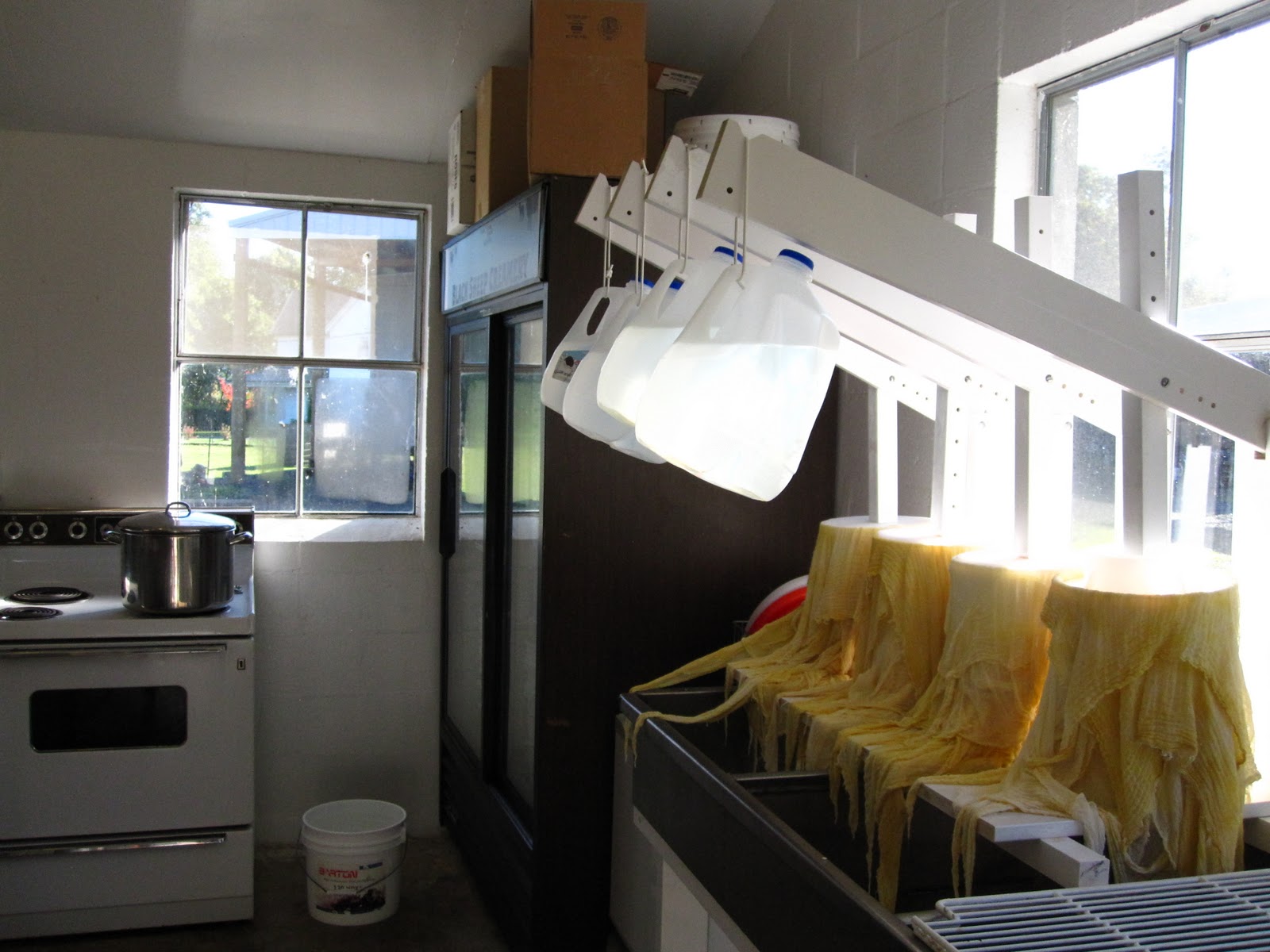
Then the whey is drained and we begin scooping out the curd (“hooping”) into molds. The molds are much smaller and lined with cheese cloth. We stack the molds to get some whey out. Then we start flipping and pressing them. The press is a home-made structure (not an air-press). It uses jugs of water as weights to create pressure. The molds go into the press. They are generally flipped three times and pressed for an hour each time. The next day they go into the salt brine before beginning their life in the aging cave.

5) Aging
The front trailer is the prep room.
If you look behind it, you see part of the
trailer used as the aging cellar attached
The cave work is similar, but less involved at Black Sheep. All cheese has to get flipped regularly to allow for proper rind development. But there are fewer varieties of cheese to maintain; so there are no blue cheeses to poke and fewer types of cheese to wash. Because there is less cheese in the cave, there is less maintenance for the structure itself. The floors stay pretty clean and the shelves don’t need to be scraped quite as aggressively. That will likely change as the cave gets older and if production increases. The cave itself is not an underground cellar like at Cato Corner. Instead it's a metal shipping trailer that has been rigged to allow for temperature and humidity control. It is attached to the back of the trailer that serves as the packaging and cutting room.

The cheeses that are washed – the St. Helens, and occasionally the Pecorino – are washed much less frequently than Hooligans. Because of the washing schedule and the recipe itself, the washed rinds here are fairly mild and not very stinky. The washed-rind cheeses here are washed with a similar salt brine solution. To encourage the orange-rind development, B. Linens is also added to this brine in small quantities. Instead of a brush, I put the brine solution on a cloth and wipe the cheeses.

The aging cellar. Attached in the
back holds the brine tank.
 One added task that arises from having smaller quantities is brushing. I’ve discussed dust mites before and the dust they create. I know the mites and molds that thrive in the cave are pretty unappetizing, but it’s a natural part of the process. I’ve seen it all and I still heartily enjoy the cheese. Flipping and handling the cheese, and properly maintaining the cave and shelves will generally take care of a lot of the dust and blemishes on the rind. The rest is cleaned off when the cheese is pulled from the cave. This fall, however, I’ve spent a few days of cave work that were dedicated to pre-emptively brushing the dust and gunk off the rinds during the aging process. I take each cheese and brush off the dust and mold blemishes and replace them on the shelf. When cheese is pulled, it is brushed again, but there should be less to clean at that point. It’s a good way to keep an eye on the cheese and see how the rinds are developing. But that would take a substantial devotion of man-power if there was a lot more cheese.

On a final note, I have to say I've been really lucky so far to work with wonderful people and find internships that have genuinely been a great learning experience. I appear to have lucked out again. Meg and Brad are awesome. They are laid-back and fun to work with, and most importantly, ridiculously patient and kind in helping me learn the ropes even as their season winds down. Both here at Black Sheep and at Cato Corner, I've had the chance to work with people who really know what they're doing and have won recognition from their peers for it. Yet, they are still generous enough to welcome a hapless twenty-something into their business, put me in touch with their cheese contacts, and in the process, support my goal. I've been very very fortunate in my path this year. Fingers-crossed that the luck continues!

Ricotta hanging at the end of
cheesemaking day. The fresh
cheese hangs in the same manner.


Daily Details, Part 1: Farm, Markets and Packaging

I’ve neglected to provide a structured view of my day-to-day tasks and duties as I did this summer. In an attempt not to be repetitive, I tried to thematically convey some of the differences in my fall posts: I’ve been working with the animals slightly more here, I’ve been doing more farmers markets, and I’ve had more responsibility in working the markets alone. But I think a better outline of my duties helps bring to life my Fall here.

Other than the increased role in farm-work, the basic cheese-related tasks are the same: make cheese, work in the aging cave, prepare for market, package orders and shipments, work markets. Yet, because the farm is smaller and because I arrived at the tail-end of sheep season, the routine for each of these steps is vastly different from what I did this summer. My two internships have been equally amazing experiences, and thanks to their differences, I’ve been offered a chance to learn a lot of different skills in a really condensed amount of time

1) Farm Work
Perhaps because of the size of the farm and staff, the cheese and farm work aren’t compartmentalized. Brad and Meg, as well as most of their staff, tend to have a hand in both. In the summer, I mostly kept my animal interaction to gawking at cute calves. Once I helped milk the cows. As you know, out here, I’ve had much more interaction with the sheep. But I never had any udder-time with them because milking season was primarily over for the sheep. Still, after having watched their most intimate courting rituals and administered to their medical needs, I feel as though we’re as much pals as the cows I milked.

Penny guards (and occasionally
antagonizes) the rams. Brutus, who's
not pictured, guards the main flock and
is almost three times Penny's size.
I’d like to give special mention to the dogs on the farm because they’re just so darn cute. Both farms have border collies with really bizarre, but endearing, personality quirks that make them utterly useless as farm animals. I don’t know much about dog breeds, but I’ve come to the conclusion that border collies are extremely neurotic. Black Sheep also has three Anatolian sheepdogs that guard the sheep from coyotes and other roving woodland carnivores. The sheep dogs are HUGE, extremely friendly, and stay outside with the sheep and rams at all times.

2) Preparing for market and Packaging orders
Black Sheep produces less cheese and milk each year than Cato Corner. Meg and Brad have been making cheese commercially since 2005; Mark started making cheese at Cato in 1999 and his mom was making cheese on the farm a couple years before he arrived. In addition, things are just starting to get back to normal at Black Sheep since a devastating flood that wiped out most of the flock and crippled the operation struck in 2007. But the main factor in size of production is the nature of the animals. Cows are bigger. They have more milk. Further, sheep are dry for longer than cows or goats. And sheep are much more difficult to breed on a rotating cycle to allow for year-long milk production. So while there are about 70-ish milk producing sheep here to Cato’s 40-ish milking cows, and both animals are milked twice a day, the sheep give you far less milk to work with in an average year. Black Sheep's cheese production is about ten-thousand pounds per year, and Cato produces about fifty-thousand pounds of cheese per year. The result is fewer people working on the farm here and cheese work that is more seasonal.

The room for all the prepping,
packaging, and cutting. You can see
through the door, the aging cellar
is behind.
As a result, preparing for markets and shipping orders is bit less systematic. For market, there is no precise amount of cheese I’m pulling. I just go to the aging cave and pick out a couple wheels of the next available batch of a given cheese. Unless something is unusual that week (an additional event or market), I generally just use my own judgment to make sure there is enough of everything prepared for market.

I had mentioned that because of various state and local laws and licensing issues, the cheese here has to be pre-cut and packaged for each market. Once a week (usually Thursday or Friday), I prepare for two markets by making sure a little over 30 pieces of each cheese is in the refrigerator, cut, vacuum sealed, weighed and labeled. Then, I inventory the prices of each piece being taken to a given market on a sheet of paper, and organize the cheese into bins to be put in the coolers the next morning. Samples are cut into little cubes and placed in a labeled container. If there is ricotta to sell for the week, then that needs to be scooped and put in labeled containers.

When I first arrived, there were about two weeks of regular milk production from the sheep, so we could also prepare the fresh cheese, which is much like a cream cheese or chevre with seasonings. This would double the market prep time and take up both a Thursday and Friday. There were five different types of flavored fresh cheese so we needed to season and make each type, and then scoop each type into several 4 and 7-ounce tubs. We also make yogurt during milking season, so that would need to be put in tubs as well. So, in the summer, preparing for market can be quite time-consuming.

Orders are fewer and come in on a sporadic basis. Unlike this summer, there are no big packaging extravaganzas built into the schedule with boxes and packing paper eating up the room. If there is an order to prepare it’s usually just a couple boxes at a time, or someone is going to Portland or Seattle to make a cheese shop delivery. Otherwise, the orders are wrapped and packaged in much the same way: by putting the wrapped wheel in a box with ice packs and insulation. If the order is a delivery, the wrapped wheel is carried in a cooler. No surprises there.

3) Markets and Events
The winery event, clearly not even close
 to the ruckus of the Connecticut
wine festival
I described most of my market responsibilities in previous posts. The biggest differences: the cheeses are pre-cut and packaged at sizes averaging about a quarter-pound, samples are pre-cut and handed out upon request by disposable toothpick or spoon…oh yeah, and I drive to and from the market, set-up, sell, and pack-up all by myself. I’m tasked with two markets each week (versus one market per week this summer). Over the course of the season, I’ve worked three different markets: St. Johns in Portland, Chehalis, and Puyallup.

In addition, I was given the responsibility of representing the farm in various events, such as the tasting event in September that I mentioned in an earlier post. I also mongered cheese at a winery in nearby Centralia during a weekend wine tour event. It was nothing like the chaos and constant action at the winery event in Connecticut. I didn’t write about the Centralia wine experience here because I was mostly a figure-head or sentry of sorts, stationed at the table to answer any potential questions about the cheese, insert a spiel about the labeled samples, and point to a cooler in the wine store where more pieces were stored. I did a little bit of that, but mostly I ate a lot of the chili they were serving there.

Chehalis market day (Admittedly,
I could have taken a better picture)
The added market responsibilities have helped me develop confidence in how I talk about the product. Plus, I’ve developed a better sense of knowing what a customer’s tastes and interests are via body language and verbal cues, as well as knowing how to deal with the occasional problem-customer throwing a fit over taste or price. I’m still not an expert, but the added interactions have given me much-needed practice. Best of all, towards end of my first month, I began to feel more like part of the farmers market community, which is a fantastic community to be a part of.

Best of the Northwest

Today I helped Meg and Brad put up new siding on the rental house behind the barn, thereby fulfilling my corporate-to-construction Office Space fantasy. I was unreasonably excited about it and enthusiastically volunteered my help. We've officially reached the cheese doldrums for sheep-milk cheesemakers. The animal work is mostly done until lambing season begins at the end of winter. The sheep stopped giving milk weeks ago, so cheesemaking has come to a halt. There is technically enough milk here, stored and frozen, for a few more batches of their mixed milk cheese, but we're in a holding pattern until they reach their source for cows milk. There are only a few more markets left, so not as much cheese to cut. My only remaining tasks are cutting/packaging for and attending the last two markets of the season: one tomorrow in Puyallup and one on Tuesday in Chehalis.

So I realize: Out of nowhere comes the end of my second internship. I still have one week left, but I don’t know where the other eight weeks went. In keeping with my usual nostalgia flare-ups, which sometimes I can only liken to a recurring rash, I’ve started to reminisce on everything I’ll miss out here. Soon, I'll fully expound in a later post on the cheesemaking details and farm work, which I have neglected to do aside from the sheep care stories and a few market descriptions. To put it simply for now, I loved my internship and working with Meg and Brad, so I'll greatly miss every detail of that experience -- except, perhaps, cutting and packaging cheese for market. Much like washing Hooligans this summer, it is monotonous and lonely. Unsurprisingly years of document review as a lawyer, trained me to excel at tuning out and powering through such tasks. The highlight of that type of duty in the cheese world is getting to notice the changes in the cheese from time and care and the variances in batches; and at least with cutting and packaging, that involves noticing changes in taste.

Loving work has been a fortunate and reliable fact ever since I began doing this. But for now, I can't leave here without telling you about some of the other great non-cheese-related Washington experiences. 

Admittedly, I've been critical about a few things here (*cough* chickens). And I even stated I might be more of a east coast girl for long-term purposes (as far as coasts go, and with the exception of Portland, which I love).  For instance, I was disappointed in the suitability of my immediate vicinity for running and outdoor recreation. The logging history of the town and the industrial park down the road create a certain stench on the sides of the highway where I have to run. There are other gauntlets on many of the roads, including the certainty of running into at least one unleashed, untrained guard dog running across the road and barking at my heels. Sadly, I prefer the smell of bum pee while running on the sidewalks of DC. That's just me. 
 
Yet, I have found one oasis that is actually one of the most beautiful roads for running ever. I climb a monstrous hill and pass a small herd of cows at pasture, a well-kept red farmhouse, a leaf-lined trail leading to a tree farm, an orchard, and at the very end, a clearing with a perfect view of Mt. St. Helens when there are no clouds. Occasionally, on the smelly highway portion that ends my route, I see a mama and baby deer prancing through someone’s yard. I've seen the same pair at least three times, reminding not to be such a cynical jackass. I will miss that run and that reminder.
    
Seeing Mt. Rainier and Mt. St. Helens on a clear day is something I will definitely miss. On some mornings, when the Rainier is especially snowy and the sun hasn’t quite reached its peak, the mountain looks like it is glowing. If I lived out here, I would always appreciate days when Rainier peaks out from behind its cloud curtain – if for no other reason than the odds and predictability of a clear day make its appearance feel a lot like the winnings in a game of roulette. 

Not even the foggiest part
of my lovely hike
When my experimentation with running routes grew tiresome, I always had the opportunity to drive a bit and go for a hike somewhere beautiful. Despite being cloudy, and at points because it was, my hike on Mt. Rainier was the most gasp-inducing, beautiful trail I’ve ever been on. Plowing through the foggy clouds, blowing frost and zero-visibility, which made me feel completely alone, disoriented and like I was about to fall off the edge of world into a Tolkien novel at any minute, just to see what was at the top of Panorama Point was at times an exercise in self-motivation. Obviously, there was no panorama to see that day, but my curiosity won out. When I reached the top, I felt like I was seeing the mountain like few people would -- because who goes for a solo hike in that kind of weather? 

Is food on this list? You know it!

The hands-down best Mexican restaurant I’ve been to is in Centralia, Washington: authentic home-cooked, warm your heart food that is widely acknowledged as the best Mexican restaurant in the area. La Tarasca was built by one mom, not unlike your own perhaps. By the taste of her food, traditional fare from the Michoacan region of Mexico, I'm imagining she gives really good hugs. It tastes familiar, the flavors so discernable that you think you can recreat it. But of course, any attempt fails miserably, which is the beauty of really good home-cooking. She makes her own fresh corn tortillas in the kitchen, which I've seen from the dining room. And you can taste the love in them. It's a simple menu, the lamination falling apart on the pages that list off a dozen staple dishes and an a la cart menu with the usuals:  tamales, chile relleno, and badass Adobada and Chorizo tacos. Nothing is flashy; the tacos are just the seasoned meat, onions, cilantro wrapped in a fresh tortilla, with a lime for squeezing. It’s a family operation, and I get the sense that 80% of the customers are regulars. If I was here for longer, I would be among them. Please note this restaurant has received  old star approval from someone born and raised in Texas, and who therefore has street cred in tasting lots of good Mexican food.

Of course, I'll miss all the delicious fresh produce I’ve bought or bartered/traded for at farmers markets. And, god yes, the bread from Russell’s Bread, the vendor next to me at the St. John’s farmers market I’ve raved about.

Proximity to Seattle and Portland has allowed me to discover many great things about city life here. I'll miss my friends in Seattle and my guilty pleasures at Pike’s Place Market: the hot mini doughnuts, Russian Piroshkys, and Bottega Italiana gelato. I try to stay at the market long enough that I can make the rounds and eat at each place …so you know, about an hour. 

I'll miss the food in Portland. All of it. No really. I’m almost positive that every single food cart is amazing. I stop at a generic Middle Eastern food cart expecting a standard kofte sandwich and I get my face blown off by a really flavorful and fresh pocket of joy. I go to a Czechoslovakian cart for something different and pee my pants when I’m presented with the fried-slab-of-cheese-between-bread sandwich. I swear I didn't special order this sandwich, and this cart has been ranked as one of the best on their food cart scene (so it’s legit). 

I wasn't here for a particularly ideal season for weather on the beach or coast, but the Oregon and Washington coasts are beautiful even in the rain. Back to food: this also includes the amazing Bosnian restaurant, Drina Daisy, in Astoria, where the stew I ate felt like a warm blanket in my belly. 

I won't miss the chickens. I'm sorry but some things have no redeeming qualities. 


Rainier on the road to the farm

Fun with Sheep

Yesterday, I put sheep in a head lock and fed them worm medicine. Today, I put on a clean t-shirt and talked cheese to customers at a new farmers market. I honestly love that my days can be so unpredictably different and full of new things that have the potential to scare me. 

The end of breeding season for most of the sheep arrived yesterday. I was told we would be resorting and grouping the sheep based on a system that my feeble mind just barely understood. Then, I heard that we would be “worming.” I had no idea what that meant, but I was frightened. I’ve never had my own pet. So, for me, hearing about someone’s pet having worms gives me the same sick shiver of repulsion that a woman who’s never had a baby gets every time one of her newly pregnant friends talks about child birth.

Worming actually wasn’t that awful. All it involved was shooting a syringe full of milky-colored preventative worm medicine into the sheep’s mouths.  After each sheep was lured into the milking parlor with the promise of grain, we waited until they had sated their hunger from the feed buckets. Then, knowing that asking nicely wouldn’t work, we hooked our arm under each sheep’s head and tried to control their squirming a bit. As quickly as possible, we tucked the syringe into the corner of their mouths and just as they had opened up, ejected the contents of the syringe into the back of their throats. That was the easy part.

Then the sheep had to be sorted into several groups all over again. We recorded the colorful markings on the backside of the sheep that had finished breeding (the marks, as you will recall, are colors that corresponds to the marker harnessed to each ram, indicating that a given ram has had its way with an ewe). Brad and Meg called out each ewe's tag number and the marking color on her butt for me to record. "10137. Green! 8096. Blue! 10058....(pause) Blue, green, yellow and red!?" One ewe apparently approaches breeding season recreationally. She wins.  We had to pull out all the bred sheep and send them out in one big group to the far pasture. Their work for the season is done. We also had to sort out the sheep that had not had any visible markings on them in the last month and place them with a “clean-up” ram to have another go just in case they hadn't gotten knocked up. 

In an exercise that encouraged teen pregnancy, we then guided the younger, chaste sheep into groups and let them have their first crack at breeding with a couple new rams. It was essentially the same process we had accomplished with the older ewes 34 days prior, except this time we would be corrupting a new generation.

Each group had to be led out to pasture separately and guided to different fenced areas. This time there were several more moving parts, as well as many young sheep that had never been through the process before and had never even seen the milking parlor. The young ones were nervous, twitchy, and needed a lot of guiding through each step. The rest hate when they deviate from routine. All the confusion and cornering of sheep to sort and re-sort groups at times led to a melee of chasing, charging, and boxing out. When one sheep wanders off confused, much strategy or bribery with grain is required to guide it to the correct spot. Even then, a skittish sheep might be a hopeless cause until it calms down. Sheep don't do anything intuitively unless it’s with the rest of the flock. At one point we had to bring back an entire flock of sheep from pasture in order to get four sheep that had been left behind to go where they needed to. They had no idea what to do without the rest of their friends.

At first, I was completely unsure of how to get the sheep to move or not move. I mostly just reacted very slowly and stupidly to what needed to be done. Eventually, I think I became a bit more useful (I hope). I kind of understood how the sheep could be wrangled and lured. I ended the day covered in worm medicine and wet sheep. I have so so much respect for cheesemakers who have and care for their own animals; or hell, pretty much anyone who has their own animals. From worms to forced copulation, it’s hard work. People ask me all the time if I want to actually make cheese someday instead of just sell it. I say sure, I love cheesemaking, much more than I even thought I would. Then they ask me what animals I’d have on my farm. And I laugh in their face. I love the experience with the animals, and I enjoy feeling less helpless around them with gained experience. But I just don’t know if I have it in me to care for my very own.

And about that new farmers market: Last Saturday was sadly the last day for my St. Johns market in Portland. I’m still in withdrawal from that delicious bread from the bread guy. I savored my last breakfast bun until it became stale. I loved the people at that market (the vendors and the customers) and really looked forward to my Saturdays. Now, I’ll be attending the market in Puyallup, Washington on Saturday mornings instead, which seems like it will be equally enjoyable. The market is longer (5 hours), but is generally much busier than any of the others I’ve worked in the Northwest. The time passes quickly and there is plenty to see, eat, and buy. During the peak, there are 150 vendors. It is the end of the season, however, so there is only about half that amount right now. Today was an unusually slow customer traffic day for this particular market, so I hope I’m not bad luck. Also, I don’t get hooked up with awesome bread and vegetables like at St. Johns. In fact, the bread vendor sucks and the Mexican food across from me is way overpriced ($4 for an empanada that tastes like a 75 cent doughnut?!). At least there’s pie from a boisterous pie guy who’s been making pies since his 4-H days in the 1950s. I look forward to trying that next week. 

I promise, someday soon, more pictures. 

My Two Markets

I've now done two markets on my own! As you might remember a mere few months ago, the prospect of a solo market made me pants-crappingly nervous. But as I had mentioned a few posts back, I was surprisingly calm about the whole affair now. I know much more on how to talk about cheese and I was looking forward to the opportunity to run my own show. The only thing that scares me on the regular is putting up the tent by myself. That thing is unwieldy.

My view at the Chehalis Market
For all the markets we do in Washington and Oregon, the cheese must be pre-cut, priced and vacuum packaged on the farm. The food handling laws and licenses for farmers markets are much more restrictive for vendors who wish to cut cheese at market in these states. I think I'd be just as confident if I had to cut cheese at the market, but it does take a little bit of the franticness out of market day. It also allows for more time to focus on the samples and conversation, and the customers can hand-pick exactly what they want. However, pre-cut pieces take a little bit of the theatrical excitement out of mongering and are somewhat more restrictive for the customer when we start running low. There are definitely pros and cons to both.

I've done both of my solo markets with the outgoing intern for the first few weeks, but now I'm the only staff member left to handle them. The Chehalis market as I mentioned is respectably sized for a blue-collar town. Depending on the weather, the customers usually come steadily in the early afternoon. But in my opinion, the market lasts far too long. It's every Tuesday from 12pm to 5pm. Granted, I've arrived at the end of market season in the Northwest, but the amount of customer traffic does not justify a five-hour market. The last two-and-a-half hours are more like a trickle of customers and pretty excruciatingly slow for the vendors. The crowd is an ecletic mix of residents, primarily families and elderly ladies of varied levels of enthusiasm for being outdoors.

St. Johns market in Portland
The market in Portland, Oregon on Saturdays takes place in the city's St. Johns neighborhood from 9am to 1pm. At St. Johns there are a few more vendors and a much steadier flow of traffic than in Chehalis. It's not as big as the main Portland market (which I assume is more like the Union Square market), but the crowd levels at St. Johns allows time to get to know your regulars (so maybe more like Ft. Greene). The crowd is much wealthier, trendier, and health-conscious than the Chehalis crowd. But both market-goers share an equal love of cheese and fresh products. In Chehalis, there is a pervasive use of questionably tight sweatpants, and in Portland, there is a pervasive use of questionably tight biking shorts. In the end, we're all the same.

One of the great things about both markets is the relationship between all the vendors. The farmers market community in Chehalis was very warm and welcoming. Everyone knew each other, and after every market day, they all meet up with their wares to cook dinner and socialize together. On my first Tuesday in town, it was nice way to be invited into to the community. It also makes the last few slow hours of a five-hour Tuesday go by much quicker when you're around people you enjoy. Even in Portland, the neighboring vendors were very laid-back and fun to work alongside. Forming connections with your fellow vendors is not always a given in the markets I'd witnessed, at least not on the first day. So both markets were a pleasant and refreshing surprise.

Very few markets in the Northwest are year-round. Most wrap up in the early to mid-fall. Portland will be over in a couple weeks and Chehalis winds down in October. This of course, means that I will be mourning the loss of the bread guy next to me in Portland, who has the most addictive baked goods I've ever had. Ever. I don't know what the secret narcotic ingredient is. All I know is that I secretly sing love songs to those breakfast buns and garlic loafs.