Through Thick and Thin

As I observed the children's cheesemaking class a few weeks ago, I watched 11-year-olds beat me at my own game. The mozzarella they made in class was a gooey, elastic beauty of dairy Gak. (I miss Gak.). My curd never quite looked like that. It always falls apart into smaller grains. Though, eventually it does come together in the stretching phase. For instance, the last batch of accidentally successful mozzarella I made started out a little grainy, but stretched out to a smooth ball that was fully functional for cooking and melting.

I was jealous of their novice success, yet, undaunted and determined to create an equally attractive mozzarella curd at home. My hypotheses for the cause of my shortcomings were 1) an overly dry curd, caused either by stirring too much, cooking at high temperatures, or a small cut; or 2) a bad set/coagulation, caused either by too little rennet, a short set time, or the poor quality of my store-bought milk. Milk quality was likely the biggest factor. The children's class was using raw milk straight from the cow. But there's nothing I can really do about that, short of getting a goat to feed off the tumbleweed in the desert bordering Mexico out back.

I attempted to mimick the curd of my pre-pubescent nemeses first with a citric acid batch, and then, with a cultured batch. I changed just a few of the factors first to see if I could pinpoint the problem. I used a little more rennet, barely stirred the curd, and cut the curd into large squares to retain moisture. It immediately fell apart. The curd was so weak and grainy that I couldn't even drain it. The curds never molded together and, instead, slipped right through my strainer, mocking me as they poured down my disposal.

So, on my next attempt, I increased the set time as well as the rennet, and I reduced the temperature to about 100 degrees during stirring. I also went back to my original 1-inch checkerboard cut. Same problem. It wasn't the size of the cut, the temperature, or any of my guesses relating to the coagulant, unless it was a combination of all three, in which case I would be making a new batch to control for each factor and sub-factor individually. I did not have the patience or milk funds to be quite that mad of a scientist.

I also surmised that the omission of calcium chloride, which I usually add to strengthen curd from store-bought milk, may have been a culprit. But the mozzarella help page on New England Cheesemaking Supply Co.'s website indicated that the omission shouldn't be a problem even with store-bought milk. In fact, depending on initial calcium phosphate and ionic calcium levels in the milk, calcium chloride may be counterproductive when making mozzarella because during the stretch you are trying to elongate the protein matrix which is held together, in part, by the bound calcium.

Bewildered, angry, and dejected, I drained my second weak batch in cheese cloth instead of a strainer so that I could actually capture some of the useless curd. For what purpose, I don't know. Punch it into submission? Face it down before it ran away in the drain and threaten that soon, very soon, its comrades would be mine to eat? Scare my mess o' curd into working for me, I suppose.
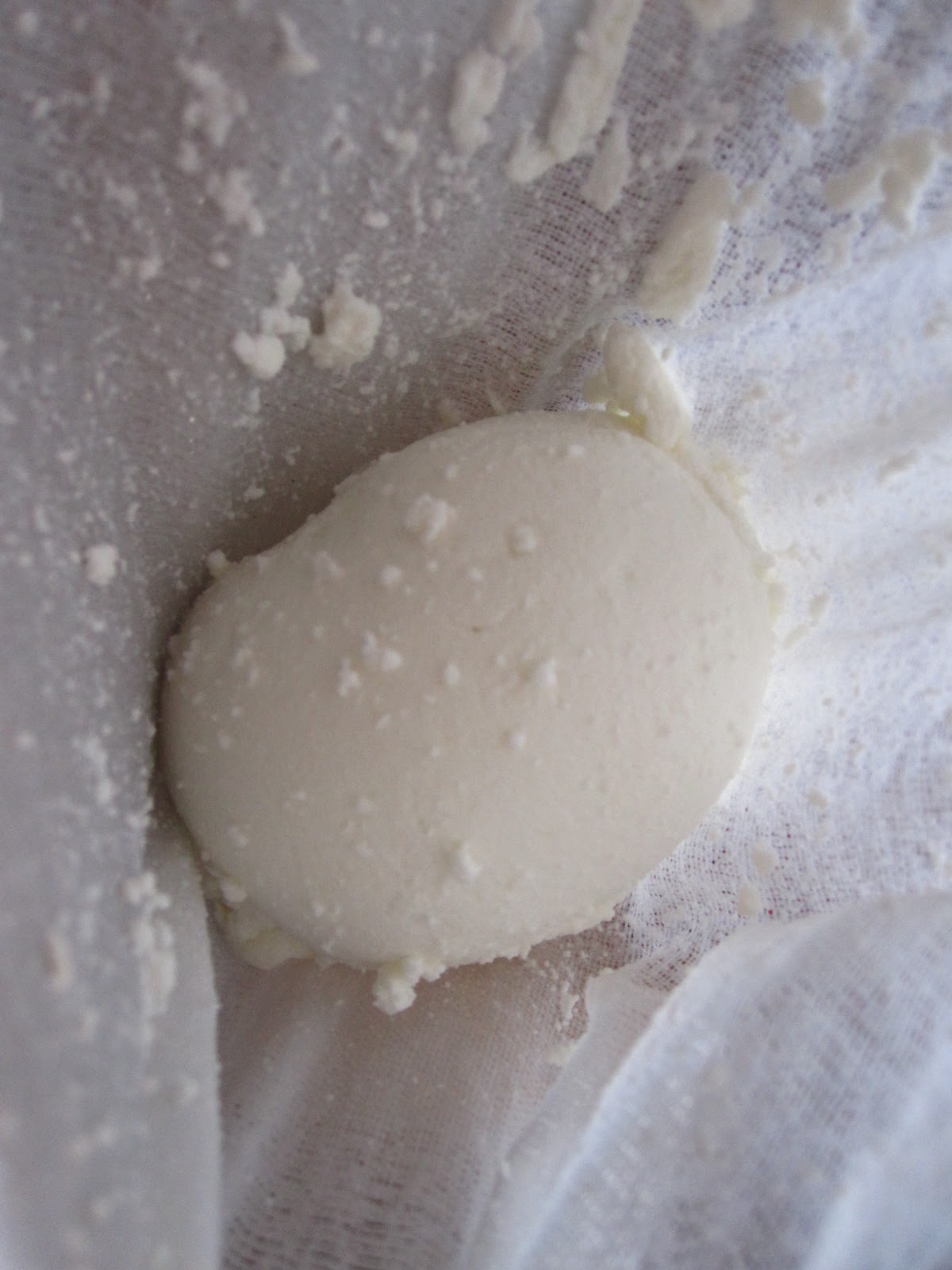
Ricotta ball
Both times my curd looked more like ricotta than mozzarella. Why not just make some ricotta with the whey, I thought, and salvage some of the cost of this failure. Ricotta, translated from Italian to "recooked," is formed when protein and minerals leftover in the whey are precipitated out with heat and acid levels.

I boiled the whey from my cultured batch until flakes of ricotta started to rise, drained it, and formed a small ball (ricotta from whey is a low-yield cheese). You can only make this style of ricotta from whey left after a culture ripened batch, not an acid precipitated batch. In other words, I can't use the whey from my citric acid batch to make ricotta. All of the specific protein that rises out to form ricotta has already been precipitated into the curd when you use acids such as vinegar or citric acid as the ripening or curdling agent.

The ricotta success was met with mild satisfaction as I casually tossed the ball into my fridge. (Stay tuned next time for the delicious journey that ball of ricotta takes.). I had wasted two gallons of milk, and was forced to re-up once again for my final attempt at a really good mozzarella curd. I had regressed from moderate success to colossal disappointment in under two weeks.

Third time's a charm, they say. But "they" say a lot of stupid crap, so I wasn't convinced. Regardless, I started again on a citric acid batch. No calcium chloride, diluted citric acid, a slightly increased amount of rennet, a longer set time, usual cut (1-inch checkerboard). Curd with store bought milk would always be weak, so again I stirred very slowly. I also heated the curd a little more, inching past the usual 110 degrees to about 115. Higher temperatures form a drier curd, which I was hoping would also be firmer and more likely to hold together in the whey. And, while the moisture would take a hit, I was hoping the the slow stirring would compensate. My last correction: using bottled water to dissolve the rennet instead of tap water.

Chlorine, which can be found in trace amounts in most tap water, will kill your rennet. When I started making cheese in the kitchen, I always used bottled water. Then I got lazy and cheap and started using tap water without any repercussion. My curd always set. It wasn't hard to believe that Del Rio's public utilities employees might be cutting some corners in their water treatment and failing to add a chemical or two. So maybe there's no chlorine, I thought? In reality, my guess is that a combination of factors in previous cheeses, maybe varying levels of chlorine or the effects of calcium chloride, masked my tap water problem.

THAT is a good stretch. That
 is also what unrestrained
glee looks like. 
A combination of poor quality milk, the omission of calcium chloride, and tap water interacting with the rennet likely had confounded my two recent mozzarella attempts. Then again, all of this is wild conjecture. The one change to my dilution, however, seemed to do the trick. After draining, I had the best mozzarella curd of my short cheese life. It was still grainer than the class curd, but I think milk quality will always affect that texture somewhat. After it was completely drained, it gelled together into a moist, gooey blob that stretched and stretched until the joy numbed me to the fact that I was burning my hands on hot mozzarella.

Home cheesemaking of late has been a series of peaks and valleys, peaking soon after I simply own the valleys of really, really, sucking at this game. I couldn't make a cheese with a proper meltable texture, so I owned my foibles and made a successful Paneer, a cheese that is meant to be unmeltable. Then, bam, my next attempt at cultured mozzarella sans pH meter worked, almost by accident. Then, I had batch after batch of mozzarella curd that was more aptly identified as bad ricotta. So, I make a proper batch of whey ricotta for the first time. Shazam! No more cheese funk and, on the next attempt, I make mozzarella curd with the best stretch yet. I'm not really sure what to call this pattern of existence. But I'm pretty sure that such a pattern -- one of simply repeating the product of failure in order to become better at the original goal -- would rarely work in other facets of life...at least not without (hilariously) tragic results. And that is one of many reasons why, despite our struggles, cheese and I remain BFFs. 

Cheese and Youth: A Sociologically Sound Guarantee of Excellence in Life

Last week at my Waco gig with Brazos Valley, I learned two things about children. One, if they are open to the idea of experimenting with cheese, then teaching them cheesemaking is a surprisingly productive and fun educational exercise. And, two, children know way too much about the use and effect of ADHD drugs amongst their classmates, and what happens when little Johnny Q forgets to take his pills. This blog is about cheese and not Adderall, so we'll leave the latter to a clever anecdote about the darndest things kids say.

I've mentioned that the good folks at BVC host an array of classes on homesteading crafts like woodwork, blacksmithing, pottery, and, of course, cheesemaking. The cheesemaking classes come in varying level of difficulty and give hands-on instruction on everything from the production to the aging. Usually, adults take the cheese classes. Every once in a while, a visiting school on a field trip will be adventurous enough to test the potentially volatile combination of grade schoolers and hands-on cheesemaking. Last week, I popped in to observe a children's cheesemaking class.

Nothing warms my heart more than a child who is daring with cheese. Most children love the cheeses familiar to mac & cheese or grilled cheeses -- the bright orange and safer versions of dairy-lust. I'm particularly awed, however, by the children who build on their conventional, youthful cheese love by dabbling in cheeses off the beaten path for a little person with such underexposed taste buds. If I meet a child who tells me they like blue cheese (and surprisingly, I've met a handful), that is a child who I know is quite advanced in being awesome at life -- a child who I look at and think, "you know kid, you're going to be alright."

Children are notoriously picky eaters. You can't really blame them for that. A child's receptiveness to foods is largely linked to both physiology and familiarity. Taste buds usually adapt to familiar and repeated flavors. If a child is not used to a food, the "strangeness," either perceived or real, may scare them away. Taste buds also become less sensitive and less abundant with age. So children prefer milder, sweeter flavors, and shy away from flavors like spices or strong cheeses that blast their sensitive palates. Generally, children become somewhat heartier, adventurous eaters as their taste buds soften, and as their parents begin exposing them to new and "unusual," healthy, fresh foods. The extent to which people open up to different foods is still, of course, based on subjective and cultural preferences. So, yes, picky eating is biological, but it is also linked, in part, to good parenting and ensuring your kid isn't a spoiled spawn who gets whatever bland junk food they want.

Kids' cheese preferences and eating habits are perfectly understandable for both scientific and gastronomical reasons. I love the warming comfort of an orange safety cheese myself (save for Kraft Singles or any brand of American cheese, which I have loathed since childhood for leaving my mouth tasting of a rubber balloon swabbed in someone's hot armpit). It's a safe bet that most people raised in this country love those cheeses just the same, at least secretly. And why not?  Boring, industrially-produced cheeses and cheese product is delightfully salty, incredibly versatile, and cooking with it makes you feel about as happy and youthful inside as sucking down a Fla-Vor-Ice on a hot day.

Fighting for position in the curd
But when kids are willing to try foods that are unfamiliar and often strange, it says something to me about their advanced open-mindedness to a world outside of themselves. To find a child who knows about different foods, who affirmatively likes, say, blue cheese, or who at the very least is willing to try unusual cheeses and foods, is to find a child who's momma raised him right.

The children I saw in last week's cheese class of elementary schoolers exhibited all the fine qualities of good-natured adventurousness with food. They were excited to try feta cheese, a salty and often unusual cheese for kids, and scream out their opinion of it, even if the review wasn't particularly glowing. When mozzarella-making rolled around, they were eager for a chance to dip their hands in the gooey curds and whey. Everyone smelled like cheese at the end and nobody complained. Okay, they might have complained a little, but they still had a grand time overall. I'm not too worried about kids like this; I think they're on track to excel...well, as long as they don't forget to take their pills. 

These Curds Can't Even Handle Me Right Now: March Madness Edition

Rock Chalk Jayhawlk!
Just your average school pride cheese.


That's right, my friends. What you have right there is homemade blue cheese on a pizza. Obviously not your traditional blue cheese. Indeed, it is instead a ball of mozzarella dyed blue.


Riding on a wave of confidence inspired by my previous batch of shockingly successful mozzarella, I went out on a crazy limb of cheese-inspired school spirit for the last few rounds of the tournament. With the last batch of mozzarella, we made a standard March Madness pizza for rounds two and three of the tournament (previously rounds one and two). It was a similar, but improved, pizza as what we had made for the Super Bowl. Now that the the field had been whittled down and my team was still standing, I really had to step up my game on the cheese and pizza front. Sweet Sixteen and Elite Eight cuisine never saw this coming through the lane.

I was working with time constraints this time. So, I opted for the quick and easy citric acid recipe. Plus, I had no idea what adding food coloring to the milk would do. I didn't want to waste cultures on a debacle born of whimsy. Turns out, milk absorbs a lot of dye. I was looking for as deep of a blue for KU's Crimson & Blue colors as I could get, and god forbid I end up with Carolina powder blue. So, I emptied a whole bottle of blue food coloring into my gallon of milk. Then I followed the steps as usual. Heat milk to 90, add dissolved citric acid, ripen for five minutes, add rennet, set for five minutes, stir for a few minutes while milk reaches 110 degrees, drain, squeeze out whey, salt and stretch immediately.

Crimson and Blue. These colors don't run.
No really, I thought the blue dye
would bleed all over the pizza, but it didn't.
Final result: Crimson and Blue pizza idea runs away with the score. The stretch was just a bit grainier than my previous citric acid mozzarella. But after cooling, and slicing, the texture was fine, and it tasted like the usual quick and easy mozzarella. Somewhat boring and bland, but acceptably delicious when melted on pizza. I went to work with red bell peppers, building a masterpiece.

Granted, if we weren't limited by my foolhardy desire to turn my pizza pie into a cookie cake and decorate it with the letters K-U, we would have had a more even distribution of toppings. If so, this would have been one of our best pizzas to date.

I love March Madness and college basketball generally. March is as close to the excitement I get at Christmas. And this is my Christmas gift to my alma mater. In spirit, of course. If we lose, I'll simply cry into my leftovers, and cheer on my remaining favorites, perhaps with more dyed cheese. I love March.

(A special thanks to Joe B and Matt M for helping inspire this idea from afar.)


Oh my, is that homemade yogurt dyed blue, and flavored with crimson cherry preserves? Seriously, I love March.


These Curds Can't Even Handle Me Right Now

All I've ever wanted from my homemade cheese was a curd I could be proud to melt on toast. After weeks of birthing curd after curd of disappointment, I've finally made a cheese I'm happy to call my own.

As I've chronicled, only three of my homemade cheese attempts have worked. The first success was the fromage blanc, which was the cream cheese style spreadable concoction that required next to no effort aside from waiting for it to drain. Then, there was the citric acid-based mozzarella recipe. While it counts as a successful cheese that worked on our pizza, using citric acid is the easy, uninspired way of making mozzarella. No cultures are involved, so there is little to no finessing the science of the make; the curd is ready to stretch immediately; and the end product is rather boring and mildly grainy. Most recently, there was the divine cheese revelation that led me to the glory of Indian Paneer. But Paneer is a niche cheese without much versatility. Still, that makes three (the yogurt has also been a success, but that's not a cheese). Every other attempt has been a monumental failure in curd, defying the physics of good food and traditional notions of edible dairy products.

I had yet to conquer my quest for the perfect... no no... my quest for an acceptable cheese curd.

The fortuitous lesson that was imparted on me by mystical cheese spirits in my last post was to first conquer what I knew best. Namely, Paneer, a cheese from my ancestral motherland that refuses to melt with the best of 'em. My cosmic luck carried over from the Paneer make, resulting in a glorious mozzarella curd that I cooked up almost purely by accident.

I followed a basic recipe for mozzarella that was similar to the Asadero recipe gone wrong. On my previous attempt with a pasta filata cheese, the curd acidified for too long and became too sour and impossibly grainy to stretch. Before that, I was too impatient and the curd was too rubbery to stretch. This time I was as careful as possible and cataloged all my steps. Heat milk, add culture, dissolve lipase in water while milk ripens for 40 minutes, add lipase, add rennet, set for 30 minutes. Then, I cut the curd so that it would be slightly bigger than usual. The larger the cut, the more whey that is retained, making a moister curd and cheese. A moister curd will also cause your pH to drop faster after the make. I don't have all day to wait until that pH gets to 5.2, I thought.

I stirred the curd for just a few minutes at 110 degrees to release a bit of whey. Longer stirring releases more whey and dries out the curd. I let the curd sit in the pot at that temperature for about an hour. Then, I hooped and drained. I let the cheese press in the colander under my standard miscellaneous heavy jug pressing rig. My lesson from last time was that I had left the curd out to acidify for too long. I had every intention of pressing and letting the curd acidify for just a few hours, before putting the pressed cheese in the refrigerator to be stretched in hot water the next day for our March Madness-edition pizza.

Basketball, bourbon, and an early bedtime, conspired to erase my memory of all cheese related tasks. I went to sleep without putting the pressed cheese in the fridge. Realizing what I had done, I woke up the next morning with cheese rage. Another batch ruined!!  To this point, failure had led me to to re-up my milk supply so many times in such unseemly quantities that grocery cashiers and patrons were starting to give me the squint eye. Each time more dejected than before, I was buying milk like a crazed, strung-out, belligerent dairy fiend. I was immediately embarrassed at the thought of going back to the store for more to try this debacle again.

With my head hung in shame, I plopped the pressed curd mass into a bowl, broke it apart, and boiled some water in the kettle to begin the sure-to-be failed stretch. I taste tested the curd. It had flavor but was not nearly as powerful as the previous over-acidified batch. Still, this couldn't possibly end well.

I poured the hot water over the cheese, and, to my surprise, it started to meld and stretch together as I kneaded it with a spoon. Whaaaa?! How could this be? It was working. I had a smooth, delicious mozzarella ball, and I sure as hell couldn't tell you how.

I have no explanation or tip to impart as to what step I did or didn't do that made this curd almost perfect, especially when the previous batch had become so horribly over-acidified in the same amount of time.

I did learn one lesson that would apply to my next attempt. Because I'm using pasteurized store-bought milk that's taken a beating in transport, I've added calcium chloride to every batch to help the curd coagulate. Next time I make a cheese that requires stretching, I will omit that step. A bit of reading indicates that calcium chloride may not be needed for a pasta filata cheese. The pH necessary for stretching is the appropriate moment when the calcium to protein ratio is such that the protein matrix in the cheese becomes pliable enough to stretch and melt. Adding more calcium to the mix may disrupt the whole process.

Of course, a pH meter would have still helped. Even though this batch was successful, I'm still driving blind and getting lucky, or unlucky as the case may be. I would have had no idea when that curd was ready. That's not true. The less scientific, more cumbersome, approach would be to start testing small pieces of curd in hot water periodically to see if the cheese is ready to stretch. Sure, on my off days from work I have all day to attempt that method. But for now, I've got basketball to watch.

When Keepin it Real Goes Right

It is no secret that I've become quite accomplished at making unmeltable cheese in my kitchen. Last week, I gave my next home cheesemaking move some thought. Suddenly, I realized perhaps this was all a sign from celestial cheese spirits to start with my roots in making South Asia's signature and stalwartly unmeltable cheese:  Paneer.

Paneer is an Indian cheese used in many curries, acting essentially as a cheese tofu because it doesn't melt. It adds texture to soupy vegetable-based dishes, but flavor is not its main purpose. For that reason -- and because it's so easy to make -- Paneer is usually a homemade cheese and not a mass or artisanally produced one.

My paneer in all its glory
Paneer is an Indian cheese. I'm Indian. Paneer doesn't melt. I'm really good at making cheese that doesn't melt. Someone wrap a bow on this perfect plan, I thought.

My curry of choice for the finished cheese would be Palak Paneer, a pureed spinach dish.  Indian food, much less the ingredients to make said Indian food, are completely non-existent here in Del Rio. After all, I am the South Asian community in town...and most people here just assume I'm Mexican anyway -- which really takes the fun out of the "guess my ethnicity" game we brown people love to play. Palak Paneer would be a rare curry for which I could find all the ingredients in Del Rio. It would also serve the dual purpose of being a delightfully green celebration of St. Patrick's Day. I'm nothing if not multi-cultural.

The milk begins to curdle in the boiling
foam instantly after adding the acid
Several variations for paneer recipes exist, but the basic idea is the same. Boil the milk, and just before it starts to foam over the pot, add an acid that will curdle (a.k.a. coagulate) the milk. Typically, I've mentioned cheeses that use a combination of culture and rennet to acidify and then curdle the milk. However, high acid levels, such as when milk is left out to sour, will naturally curdle the milk over time. Really high acid levels will wad-up the protein even more quickly and without the need for rennet. So, the addition of something like vinegar or lemon juice will get you instant flavorless curds.

The fluffy curd is finished when it has
completely separated, leaving behind
only clear whey
I started with two quarts of milk and opted to use citric acid powder because I had it on hand with my cheesemaking supplies. I have only used the citric acid once in a quick and easy mozzarella recipe made without cultures, so I had no idea how its potency compared with basic lemon juice. Either I didn't dissolve the citric acid  in water properly or I used too much, but I didn't care for the consistency of the curd it produced. The curd was rough, dry, fractured and formed too quickly. The key to making Paneer is adding the acid slowly in increments as the curd begins to puff up like clouds in the foamy pot. I ditched my first attempt and started over with lemon juice.

Lemon juice & pure
citric acid
Again, I started with two quarts of milk. A split second after the foam started to rise over the pot, I frantically added lemon juice concentrate. (I recommend using a deep pot.). Before starting, I had poured about four tablespoons of juice in a glass. As I slowly poured from the glass, the milk that hadn't spilled over into the burner started to form tufts and calmed the bubbling milk. I added a little at a time until the puffy white curds separated completely from the clear yellow whey. By the time the whey was completely clear, I had probably used only about a tablespoon or two of the lemon juice in the glass. And I had a fluffy, moist, thicker curd.

My pressing rig
The two quarts didn't produce quite enough curd, so I repeated the steps with a second batch. I pressed the two batches with various heavy jugs in cheese cloth-lined net to drain some whey. Finally, I had the the desired curd to mold into a block. The finished cheese was about two inches thick after pressing and then molding it into a small tupperware container. One variation I found on the recipe that I may try next time is adding about half a cup of yogurt to the milk. My guess is that the extra ingredient would produce a better texture.

The next day, I cut the cold paneer into cubes resembling tofu, and added it during the final stages of cooking the spinach curry. Paneer disappears into the green soupiness, softening but never melting, and surprising you with a chewy morsel in random bites of delicious curry.

Come join me for an Indian feast
on St. Patrick's Day!
Despite my ancestry, I've never commanded any legitimate respect when it comes to cooking Indian food. The recipes my mother gives me never turn out quite as authentic when I make them. Yet, I think I made the motherland proud with the Indian dinner I had concocted:  Palak Paneer with my homemade paneer; mango lassi, a mango yogurt drink made with my homemade yogurt; and baked chicken with tandoori spices. Everything, especially the cheese, looked and tasted perfect. Oh those wily cheese spirits, always know exactly how to get you out of a rut.


Lessons From the Field

I really need a pH meter. I didn't want to admit that. Never being one for exact measurement in cooking, I wanted to think that I could just whip up some homemade cheese with instinct and a dash of love like an Italian grandmother making pasta sauce. I, in fact, cannot. On the other hand, it could just be that when left to my own devices at home, I suck at this.

In the last few weeks, I attempted to make a few more batches of homemade cheese. My next attempt was Asadero cheese, a Mexican-style semi-soft, melting cheese that is made and stretched in a manner very similar to mozzarella (and one of the only cheeses readily available here in bustling Del Rio, TX). Stretched Italian cheese = pasta filata cheeses. Asadero is sort of in the same family, but a cousin from a different country. Another nearly identical Mexican sister cheese is Queso Oaxaca, but whereas Oaxaca is stretched and rolled into a ball, Asadero usually stretched and pressed into a flat block.

Another lesson: If you get distracted
watching reruns of The Fresh Prince of
Bel-Air,
then your temperature will
get away from you. 
Instead of using citric acid like I did with my first stretched cheese, I wanted to get wild and try some actual starter cultures. I used a really crude recipe I found online. (Corollary lesson: I need to be more diligent about finding a book or other source for more tried-and-true homemade cheese recipes.). The milk needed to ripen for slightly longer with the starter versus the citric acid.  Otherwise, the steps were essentially the same as my mozzarella attempt.

The final product was not what I wanted. With the citric acid, the cheese eventually stretched and formed a shiny mozzarella ball. It wasn't gooey, but it was appropriately melty on our homemade pizza. The flavor was boring and there was a bit of grainyness in the bite, but it did the job. This Asadero was all off. I was both impatient and completely clueless. Ideally mozarella or cheeses with similar make processes need to reach a pH of approximately 5.2 to accomplish the desired elastic stretch in the hot water or whey. Any higher and the curd will be wet rubber; any lower and it will be too grainy and fall apart.

My first attempt was rubber. I stretched too soon. With many mozzarella recipes, the curd is left for as long as it needs to properly acidify, sometimes sitting out until the end of the day before being stretched. I waited maybe an hour.

My second attempt was a grainy mess. I was too patient. Actually, I was unconcious. I finished the curd at the end of the day and left it out overnight to acidify. Without a pH meter, I was driving blindly on a desolate two-lane highway back to Del Rio without headlights; I had no idea when I had reached the border, drove straight through Mexico and found my confused ass in Guatemala with a big mess on my hands.

Curd
When I taste tested the curd the next day, it tasted better than previous batches and had a creamier texture. It also had the same tart yogurt or sour milk flavor that was indicative of a pH drop. It was maybe a bit too sour, but I still had high hopes. The curd mass started to meld together when I doused it in hot water. Unlike the previous rubber batch, it started to soften. Yet, when I began to pull it apart to to start stretching, it simply crumbled. I likely waited too long and let the pH drop too low, but I suppose I will never know.

The second softer but grainy batch, had much more flavor than the first rubber batch. ... So...I guess, that's...something...? But neither batch would melt. I may have cornered the market on making un-meltable cheese.

Thinner, milder yogurt
My other production note from the last few weeks is related to yogurt. I had mentioned previously that incubating the yogurt at a lower temperature should create a thinner and sweeter product. I accidentally tested that assertion this week. I unintentionally let the temperature on my pot drop closer to 100 degrees, rather than the 110-120 degree benchmark I had been regularly using. I like a thicker tart, Greek-style yogurt so I had no desire to change my methods. The lower temperature resulted in a yogurt that was more like Yoplait yogurt than Greek yogurt. After I tried to drain it for a couple hours as I usually do, I realized this batch wasn't going to get any thicker. It was a nice change of pace. Instead of a hearty Mediterranean yogurt feast, I had a much milder yogurt that was better for snacking.

My last bit of news is that I've recently started working two days out of the week in Waco at Brazos Valley rather than just one. The commute seems much less ridiculous now that I'm not driving more hours than I'm working. Not only have a I really taken a liking to the job, but I also really like making a cheese that comes out like it's actually supposed to. Don't worry, I won't give up in the kitchen. I'll just have less free time to waste milk. But stay tuned for more details from my adventures in Waco soon.

Cheese Extinction

The December 2010 closure of Sally Jackson's cheese operation in Washington state was depressing news in the cheese world. A founding mother of the artisanal cheese movement in the United States, Sally Jackson had been making cheese at her farm in Washington since the late 1970s, positioning herself as a revered cheese pioneer. After over 30 years, Sally Jackson's beloved cheeses had achieved gastronomical fame. Upon the closing, members of the cheese community sent her off with tributes fit for a cheese celebrity (full coverage of the closure and a five-part tribute on the Pacific Northwest Cheese Project).

After recalling cheese that federal inspectors had linked to a string of E. Coli illnesses, she opted to simply call it a cheese life well-lived and retire. At first, the articles on the closure forced me to ponder the nature of food safety, the risks inherent in all of life's joys, and the wisdom of various federal regulations affecting cheese. After ruminating on it further, I ditched these more esoteric subjects and focused on something far more unsophisticated. I will never ever have the opportunity to try Sally Jackson cheese. It is gone forever. A lost species. An extinct cheese that no soul who hadn't already had the joy would ever be able to experience in the future. I just had my mind blown. You won't even be able to find this stuff on ebay like Crystal Pepsi.

I had heard the rave reviews. I had even contacted the legend herself in my search for cheese internships (she didn't have the facilities to make room for an intern). Yet, I never crossed paths with her cheese. It wasn't readily available where I lived. And even during my brief stay in the Pacific Northwest, it never occurred to me to actively seek it out over all the other new cheeses I was stumbling upon. There's no hurry, I thought. I'll run across it someday. Then, boom! Food asteroid.

With a product like artisanal cheese that relies so heavily on scientific exactitude, personal touch, and expertise, there is no chance it can truly survive past the life of its maker. Artisanal cheese is not like a casserole that lives in its recipe. The varied flavors that make cheese a never ending exploration are born from a confluence of very particular factors:  The aging, or affinage, methods used and the aging environment itself. The local flavors from the pasture land picked up in the milk through the animals' grazing (a.k.a. terroir). The varied, if not proprietary, blend of cultures and production methods perfected from years of learning and trial-and-error. The chosen acidification, or pH, curve that results in the desired texture and flavor. And, most importantly, the cheesemaker's intimate knowledge of their cheese. Because there are so many factors in cheese production, some artisanal cheeses are also discovered purely by accident. More than a few cheesemakers I've know have developed popular and signature cheeses that were born from an accident, perhaps from an erroneously executed production step or an incorrect pH. Each of these cheeses, by virtue of its birth, has qualities only linked to its maker. Whether it be an accidental or intended result, a seasoned cheesemaker can often sense variations in consistency just by the feel of the curds or the smell of the milk.

Sure, there will always be general categories of cheese out there. Those that are industrially produced:  Kraft Singles aren't going anywhere. Or those that are subject to regional controls in exported European cheese:  AOC or Appellation d’Origine Contrôlée standards, for instance, that require certain production and geographical qualifications be met before, say, a Camembert can really be called a Camembert (just like sparkling wine isn't really Champagne). But unique hand-made, small batch cheeses, inspired by either creativity, expertise, or happenstance, are not a protected breed. Explore them while you can because any number of destructive factors can snatch them right out of their habitat. 
An extinct, or at least subsequently modified, cheese cutting apparatus
at the Petroleum Museum in Midland, TX.  Yes. The Petroleum Museum.