For Daddy

Before I made the phone call to tell him the truth, I mulled the difficulty of living a covert double life.

I was leaving the law firm. No big deal. People leave their jobs all the time. I was also abandoning my search for any legal jobs. Okay, kind of a big deal. He’s going to wonder how I’ll pay the bills and loans. I would be spending the next year or more working with cheesemakers and cheese shops to learn the business of cheese. Yeaaah. He was going to demand I come home to convalesce from my mental illness.

Maybe I could pretend I’m still lawyering for the next few decades, I thought. I’ll just throw out some terms occasionally. Contracts. Deposition. Objection.  

To that point, the reception for my change in life course had been mostly positive. Yet, I was not without critics and deserters. They were easy to ignore, however, because nobody had anything invested in me. I owed them nothing. I owed my father everything.

He left behind the adventures of serving in the Indian Army and the familiarity of his home country to live in some of the backwateriest regions of the American South that a non-white immigrant could have the misfortune of experiencing circa 1970. He worked menial jobs to put himself through a doctorate program. He helped run a successful veterinary practice, and eventually became a civil servant with the USDA. Each decision made for the good of his family. He put me through a private high school, four years of college, and helped me anytime my loans fell short in law school. 

I, on the other hand, was leaving a career path that he helped subsidize for nothing but my own sake. To my surprise, he didn't see it that way.

“Learning about business is good. It’s smart to start from the bottom. So you’ll open a cheese shop maybe? Tell me when; I can invest in it. We’ll put mummy to work behind the counter. She likes sales.”

It was the easiest, difficult conversation I’d ever had. As parents, and especially as South Asian parents, mine always surprised me. They never pressured us to get married; never quizzed us about giving them grandchildren; never made us feel guilty about moving away from home to pursue our lives. My dad wanted his children to be happy, no matter what that looked like. 

When I told him I had started training for and signed up to run a marathon, he sounded concerned. “Oh that’s very far to run. What if it’s hot? You know if you get tired or exhausted, it’s okay to just stop and leave.”

That’s. That’s just the worst advice ever. But each time he gave similarly terrible-seeming advice, I realized that behind his worry was an effort to remove our worry. He would remain proud; just having the courage to try was enough for him. Despite the potential that I would actually just give up, my parents were the only ones to travel to Chicago and Disney World that year to support Tad and I as we crossed the finish line of two marathons.

His unconditional support was an outgrowth of his generosity. My dad took the courtesy – or often cultural imperative – of offering guests sustenance one step further. His welcome mantra was “here take all of this.” 

My dad would hunt for excuses to give us everything he had.

“Daddy this coffee is good.”
“Oh you need coffee?”
“No we have coffee at home; it’s okay.”
Two weeks later a box packed full of his latest Gevalia shipment shows up at our doorstep.

Tad jokes that the government budget cuts prevent his office from ordering new pens.
Daddy goes around the house collecting every stray pen he can find, giving Tad two handfuls of various promotional writing instruments.

My Dad makes a friendly Superbowl bet with Tad every year. Ten dollars for pizza.
Oh the Broncos lost? Well, there’s $10 in the mail for you anyway.

It was a running joke amongst my high school friends to guess what my dad would scrounge up to give them when they came over. Jugs of orange juice. Every jasmine bloom from my mom’s plant (to my mother’s dismay). Entire 12-packs of Diet Coke.
“You want Coke?”
“No, thank you.”
“But look we have so much. Look, here, take all of this.”

My daddy was the most soft-hearted person I've ever known. At times, it left him open to being taken advantage of by contractors, businesses, and even family members. But who cares really? If, like my dad, we could all hold on to our innate goodness even when we’re being totally screwed, we'd build a happier world.

We had disagreements, and I’m sure there were disappointments at times. I second-guess whether I could have done more, been a better daughter. I question what happens to him now and whether the things we believe, or tell ourselves we believe, about the afterlife are just delusions of comfort. What is this “better place” really? When he didn't wake up that Tuesday morning was he anywhere? Can he watch over us now or is he just gone forever? I have to believe at least some of what everyone else says: he was proud of us and he knew how much we love him. To believe otherwise now that confirmation of those facts is impossible would spell certain insanity.

Millions of people suffer painful loss of some kind every day. There is nothing that makes my loss any greater, more tragic, or different in any way. It simply feels insurmountable because it is mine. Much like my mother's grief for her best friend of almost 50 years is her own. I have to hope that eventually the tears will run out and the pain will cauterize itself. Perhaps when enough time has wedged itself between the Tuesday before the blood moon and sometime beyond – enough time that I can no longer play a macabre version of I-spy life before my daddy died: The last time I wore this shirt, my daddy was still alive. When I bought this gallon of milk, my daddy was still alive. The first time I heard this song, my daddy was still alive.

My dad shuffled his feet (I've noticed that my sister and I often do the same). He loved old movies, action movies, and the Andy Griffith Show. He had many friends (I learned from him). His heavy cologne would rub off on the seat belt. When I drove his car, I hated that. Now, I will miss it. His comb-over would flap in the wind, and I’d beg him to get rid of it. He always had a mustache. When I was eight, they shaved it off for surgery, and I was terribly confused.  He would always warn me of food recalls and remind me of birthdays. He ate a lot of bananas. Some might say too many bananas. He had nicknames for many people. He called Tad, James Bond. He was always good for the ego. 

And someday when I fulfill the goal that I nervously called to tell him about four years ago, he'll hopefully be able to see it. Maybe it will be a cheese shop. And maybe he'll find a way to tell me, "you know, if it fails, it's okay."

A Tale of Two Cheese Books

Once upon a time, I told you about a cheese-themed novel. A novel, which brought both shame to the written word and anger to my eyeballs. The Long Quiche Goodbye was a book that showed me the grave error of judging a book by its bemusing title.

When a friend handed me The Telling Room: A Tale of Love, Betrayal, Revenge, and the World's Greatest Piece of Cheese, I was wary of reading another cheesecentric novel. But by the end I learned another lesson: a book about cheese can be wonderful if it is written by a W-R-I-T-E-R. The latter book was penned by accomplished journalist and storyteller, Michael Paterniti. The former novel's creator, Avery Aames is masquerading as a "writer", parading a multi-novel resume of books and stories. Indeed, she is as much a writer as a paint-by-numbers enthusiast is an accomplished muralist.

The Telling Room traces the rise and extinction of Paramo de Guzman, a cherished family cheese made by a farmer in the Castilian highlands of Spain, exported across the world, and coveted by food lovers from American cheesemongers to European royalty. The cheese itself was destroyed by the business politics of the cheesemaking facility's expansion -- a destruction which the creator of the cheese believed was owed to the machinations of his best friend.

Indulge me with a bit of melodrama when I say the story connected me emotionally to the cheese itself and to the greater tragedy of cheese extinction. I've mentioned the surreal nature of taste transience. A flavor may enter this world and leave it just as quickly if the right people and conditions are not there to help it carry on. I can't help but feel some disappointment to know that I will never taste and experience the cheese in this story.

Paramo de Guzman is also a facilitator in this book. It enables the coming together of family and friends in the Spanish "telling room" (literally the room above the cellar where the wine and cheese ages) to laugh, live and eat. Like all family recipes, the cheese lifts the spirits of the Castilian family and reminds them to enjoy life and all of its stories. Come what may with the failed crops, the sick herds, or the daily rigors of toiling in the harsh Castilian sun, Paramo de Guzman is at the center of the table. That is, until it isn't.

The Telling Room is not without its pitfalls. The author's cheeky homage to the footnote--some of which span multiple pages--quickly traded amusement for exhaustion. If the anecdote or history lesson is important enough to expound upon, it belongs in the text.

Though the cheese and its creator, Ambrosio Molinos, are the subjects, the hidden protagonist is the art of storytelling, of which Ambrosio proves to be a master. The author's insistence on immersing himself in the first-person narrative, closely befriending the cheesemaker himself and moving to the village of Guzman to uncover the story, betrays his journalistic mantra to actually tell the story. We experience a meandering chronicle of the author's experiences in Guzman with his family, but we don't get the factual account of the betrayal or the narrative of the supposed betrayer until the final few chapters.

Cheese stories aside, the point of the book is to remind us to suck the marrow out of life and cherish the pace, fervor, and simplicity of the Castilian way of living. A way of life with which the author is so wholly enamored that he steps into the frame to experience it.  A way of life that would have every reader believing Ambrosio's mantra that "the three highest things in life" are "to eat, to make love to a woman, and to shit." (Because, as he notes, to shit well you have to take the time and care to eat well...don't ask me how the second element fits in.).

Now, I'm not one to casually tear apart someone's creative work. That is, unless the creator wastes my time and stains the collective cultural library of thought with garbage like The Long Quiche Goodbye. I'm especially not particularly comfortable laying criticism on the work of someone I really admire. So, it puts me on the nauseous side of uneasy to classify the third cheese book I read, Cheesemonger: A Life on the Wedge by Gordon Edgar, in the same canon of books that make me scream "let the writers do the writing!"

Gordon Edgar is one of the pioneers of the American artisanal cheese movement. Like all present-day cheese celebrities who were presented to cheese society decades ago (before cheese was even cool), he paved the way for lowly people like me to really dream of making a living at it. I've seen him speak before at a cheese conference and it was magical. I respect him and his superior knowledge of cheeses, cheesemaking, cheesemongering, and all things cheese. But, if you read his book without that foundational respect, you would get to the last page knowing a little more about raw milk and feeling confident that cheesemongers are definitely not writers.

Cheesemonger tries to link Gordon Edgar's life on the punk rock scene in the 1980s with his entry into the cheese world as it was just emerging in the United States. He does throw in some well-researched facts on cheese politics and a smattering of amusing cheesemongering anecdotes. But like all writers who aren't really writers, he forgets the importance of details. For instance, the loss of farmland to urban sprawl is purportedly a tough and important topic. Telling us that you've "talked to quite a few dairy farmers who are thinking of either moving away from their family's farming region or getting out of the business altogether," gets us nowhere closer to understanding the issue. What farmers? Where? How many exactly? What was their story?

The punk rock dynamic to his attempt at a story arc also fails. An honest examination of the 1970s and 80s musical and political movement alongside a thorough examination of the rise of a fringe food movement like artisanal cheese might have gotten us somewhere. But to draw analogies between the enzymatic reaction of rennet to the angsty atmosphere of the 1984 Rock Against Reagan concert is disingenuous to both topics. The punk rock scene had its poseurs, its nihilists, its anarchists, its straight-edge kids. To lump them all together and use punk as a vapid adjective ("my tight punk rock jeans"), is like telling someone you like cheese because it's milky. The tragedy is that his activist stories could be great. Cast in the proper storytelling framework, the parallel evolution of a punk rocker and a cheesemonger could be compelling. But without the writer and without the story, you're left thinking: We get it dude. You were totally punk rock and now you're totally cheese. Can I get my $20 back?

The number of cheese celebrities willing to contribute blurbs of praise to the back and front of Cheesemonger is sobering. A testament, perhaps, to Mr. Edgar's importance in the cheese world. But I'd like to believe that some successful people out there have principles. And I know mine. No matter how high I (hopefully) climb and whose prestigious cheese ass I have to kiss to win favor, there is one thing I won't sacrifice: my allegiance to the written word.

The Importance of Being an Eater

Endless combinations of pairings
With the second semester of cheese classes at the Kitchen under my belt, I have a better idea of what people enjoy: making cheese and drinking booze.

Setting aside any variables like advertisement, promotion, or timing, the three home cheesemaking classes had slightly higher average attendance than the three cheese tasting classes, with the exception of the wine and cheese pairing class. The cheese plating class and the raw vs. pasteurized blind tasting were successful in their own right; and the students in attendance seemed to really enjoy them. But for whatever reason, the current ebb in cheese demands (at least here) are in the more practical pursuits:  How to be self-sufficient. How to create your own edible product at a lower cost and higher quality. How to entertain your guests.

Unless you have a gathering of cheese and/or food nerds like me nobody is going to care about the family recipe and terroir behind a raw milk cheeses or the manifest bravery of attempting to create the perfect pickle and cheese pairing instead of throwing a bunch of grapes on the cheese plate.  Nobody -- or at most a scant group -- cares about parties like that. People do care about what's to drink and what you're eating with that drink. Because, let's face it, more people will come if they think there will be punch and pie...and the punch is heavily spiked.

We've come a long way in the last decade gastronomically (that odious term "foodie" aside), especially in caring about the effort and creativity behind our food. But the art of eating can still seem daunting at times. Perhaps the idea of admiring this final step before everything mixes with the bile in our stomachs is still seen as a lofty and self-righteous pill administered only by foodies and urban glitterati. After all, a cheese plate and accompaniments curated from a specialty shop is expensive and often a luxury, yes. The idea of reaching a palate epiphany from obscure, pricey, or glamorous foods is a combination of daunting, silly, and uncomfortable for the casual citizen of consumption. But the calculated appreciation of how flavors are created from so many individual parts is not relegated to fine foods. When it comes to the art of eating, everyone is an artist.

Six cheeses, six wines, one port, one whiskey,
and a cheese wheel = a good time
The take-home point in all three tasting classes was that there are no rules to a good pairing. There is no cheese law that says a raw milk cheese is better than a pasteurized one. Taste is not related to cost. Everyone, especially those damn foodies, will pretend to be an expert on the best pairings or the most amazing meal in the world. But a good cheese, a good pairing, and a good meal is whatever you enjoy. It's the company you keep when enjoying it. There are guidelines that may help you achieve a delightful flavor revelation. But the beauty in digestion is taking the time and care to notice the food in front of you -- from the love in your mom's pancakes to the medieval history of Parmigiano-Reggiano.

At our core all creatures in the food chain are inherently gluttons; we want our prey quickly and we want to eat our share faster yet. Caring about the act of nourishing our bodies, the community in eating, and the story of our sustenance sets humans apart from our primal brethren (at the very least) and unites us as people (at the very best). If you look at it that way, a tasting or pairing class isn't so intimidating...the booze probably also helps.

Winter Cheese & Airport Security: Americans Do It Better

I have always loved fall and winter. You know what's better than hot, sweaty summer discomfort; better than pit-stained tank-tops on sweaty men with hairy shoulders; and better than the smell of b.o. and back-alley public urinals? Warm blankets by the fire; sweaters, scarves, mittens, and completely-clothed strangers; a blast to the nose of caramelized oven-air from fresh batches of gingerbread or holiday cookies; averting those same fully advertised public urinals in fresh snow. The best thing of all about the colder seasons? The cheese.

Winter cheeses are traditionally richer because winter milk is higher in butterfat late in the lactation cycle. Milk composition is also affected by diet changes in winter months, when feed is supplemented by grain and silage as colder weather begins to limit pasture availability. What winter milk lacks in grass-fed nutritional benefits and delicate flavor nuances of terroir, it emphatically reconciles with a body slam of intense, fatty, unctuous, creaminess.

And guess what America? Despite what the old-world traditionalist and globe-trotting, new-age, landed gentry might tell you, the finest winter cheeses in the world are not all found in Europe. Two of the very best seasonal cheeses are American born. Both Rogue River Blue and Rush Creek Reserve also happen to appear on my list of foods I would request for my last meal on Earth.

Just last year Rogue Creamery's Rogue River Blue was named one of the best cheeses on the planet at the World Cheese Awards in England. The Oregon cheese was one of the first American-made cheeses to be exported to Europe (and for a long time only one of two American cheeses being sold in Europe). It is without a doubt my very favorite blue cheese. If I could find it for under $39/lb, I would buy it by the wheel.

The cost is absolutely worth it. Released only in the fall and winter when richer milk is available, it disappears again around late February and March (depending on demand). It is creamy and peppery, with a sweet nuttiness owed to being wrapped in grape leaves that have been macerated in pear brandy. The green leaf-ensconced wheel is reminiscent of the of the Spanish blue, Valdeon, similarly wrapped in Sycamore leaves. Valdeon is a delightfully peppery blue in it's own right. But in a head-to-head match up Rogue River Blue is the Maserati facing off against a guy riding a Rascal in a street race.

The second amazing winter cheese is Uplands Cheese Company's Rush Creek Reserve from Wisconsin. In 2011, I experienced Rush Creek Reserve with a good friend and fellow cheesemonger for the first time. We were both left on the verge of tears. At its peak, Rush Creek is a spoonable, thick, joy-filled custard dance of bacony, beef brothy, woodsy, and sweet grassy flavors. It is a small washed-rind wheel wrapped with spruce bark and sold whole. I call it a friendship cheese because the whole wheel is meant to be eaten in one sitting with good company.

Rush Creek Reserve pays homage to Vacherin Mont d'Or, a cheese nearly identical in appearance and style. Like many winter cheeses, Vacherin follows an Old World cheesemaking tradition based on transhumans, or the movement of people and livestock with the seasons. In the Alps, after the summer months are over and the reckless partying up on the mountaintop pastures comes to a close, the herd makes its way down to the valley for the colder winter months. The milk during this season, while fattier, is less bountiful. Therefore, the cheesemakers don't have quite enough to make the larger wheels of hard Alpine cheeses. But they do have just enough to make the smaller gooey wheels of Vacherin. Uplands Dairy honors this tradition by only making Rush Creek during the winter months, and making their firmer, larger Alpine-style Pleasant Ridge Reserve during the spring and summer when the cows are on pasture.

Vacherin and Rush Creek have similar flavor profiles, but in many ways Rush Creek does it better (in my opinion). Vacherin is an exceptional cheese with many devotees. It is equally worth the anticipation of Winter. But it is slightly more vegetal and not quite as beefy, bacony, and bold as Rush Creek. If you have the misfortune of being a vegetarian, then Rush Creek is a far superior route to a meaty flavor fix.

Washed rind cheeses like Rush Creek and Vacherin are potently smelly, especially when un-refrigerated. So let's say you are carrying a wheel of Rush Creek reserve in your carry-on luggage. You should, then, be prepared to have everyone assume you haven't bathed.

On a recent trip back to NYC, the very friend who shared that weirdly existential moment of first eating Rush Creek kindly gave me a wheel to take home. Knowing that I'd be hard pressed to find Rush Creek Reserve anywhere in Texas much less in Del Rio, I guarded that cheese with my life and kept it in my carry-on near my jewelry and wallet. If someone shoved rotting vegetables and a gassy toddler into my backpack, it may have come close to matching the smell. This did not please TSA. The multiple other greasy, brick-like pieces of cheese next to it also did not please TSA.

There was a moment of terror in my heart when I suspected the Rush Creek reserve may have sufficiently warmed and become too runny, and thus, akin to a liquid. I began pep-talking my gut, imagining I'd have to sit next to the security line and eat the entire wheel by myself before going to my gate. It would not be thrown out. Fortunately, a quick scan and second trip through the x-ray proved it was not a foul-smelling explosive device.

I've traveled with cheese in my carry-on many times. Each time, my bag is searched. Each time I see the bemusement behind the askance looks the TSA agents give me. And I have to believe I've made their day a little brighter. I suppose a TSA agent's job is a lot of discarding shaving cream, reading the fluid ounces on obnoxiously-sized perfume bottles, re-scanning mouthwash. Pretty boring stuff. Imagine the joy of uncovering a sack of delicious winter cheese! Finding the most well-fed malodorous holiday traveler of them all! Maybe it's just my imagination, but I have to believe those winter cheeses performed a Christmas miracle: making a TSA agent smile.

Winter really is the most wonderful time of the year.


Shepherds of Cheese: A Journey

It's been a while. I know. Living the cheesy life in Del Rio has been getting progressively better. But as it is wont to do, Life got in the way a bit.

Shortly after I connected with the Kitchen in town where I could teach cheese classes, I also started working a nine-to-five day job because, well, my student loans keep reminding me that a graduate degree might be one of the worst investments around. I am fortunate to have found a great work environment and an opportunity to pay the bills during our Del Rio tenure. But at the end of the day it does what most day jobs do: leave me too tired to pursue life passions. In sum, I haven't really been making much cheese at home lately.

That's not to say I haven't had any cheesy stories to tell. I've just done a bad job of motivating myself as both cheese and writing go. I aim to fix that.

Let's talk cheese classes first. Since we last spoke, I started the second semester of classes. Last semester, I focused on home cheesemaking. This semester I decided to focus on, my favorite, cheese-eating. The difficulty of doing a series of tasting classes in Del Rio deserves the attention of its own post.

For the cheesemaking classes I could just order my supplies from the internet, prepare a demo batch the day before, and repeat in class. Doing a tasting class requires considerably more planning.

I've said it before, but as it pertains to cheese, Del Rio is, in a word, lame. You have to go to San Antonio if you want something other than Oaxaca cheese, or a block of Manchego that's been in plastic vacuum wrap for months and, though "imported," may well have been made from the milk of Del Rio's stray cat and dog population from the taste of it. So tack on a 2.5 hour trip the weekend before class. This also means I have to time the class according to a scheduled and independent need to leave town such that I'm not blowing $100 on gas just to get cheese.

To add insult to injury, there is no cheese shop in San Antonio. The options are Whole Foods or Central Market, both of which have acceptable selections. They're acceptable, that is, if you don't mind sifting through the pre-cuts, having zero personalized help from a cheesemonger, and paying a hefty mark-up.

Shopping in a specialty grocery store also means: 1) I have to be vigilant about re-wrapping the cheese in breathable cheese paper or wax paper so it can sit in my refrigerator for an entire week before class, and 2) I have to be extra vigilant about looking at the "pack date" on each pre-cut.

Both of those points are often overlooked, but crucially important. Sure if you're snagging a piece cheese from your local mega-center-supergiant-market that was packed and shipped in a vacuum seal, then it was either made to live that way or there's just nothing you can do about that faint taste of plastic. But a piece of Montgomery Cheddar or perfectly ripened Taleggio should never be suffocated by the succubus of shrink wrap for days on end. It should be left intact until shortly before it finds its forever belly, at which point it should be delicately caressed by a carefully folded wrap job in wax or cheese paper. If you see a piece of cheese with a pack date of more than a couple days, and there is any warm body behind the cheese counter, then you insist (nicely) that they cut you a fresh piece. And then you rush that piece(s) home and immediately transfer it from its plastic coffin to wax paper. The cheese and your tastebuds deserve no less.

The importance of who that warm body behind the cheese counter is also of importance. I've been a cheesemonger. I'd like to think a decent one, but at the very least, one who cared about and loved the product. But I also know from the consumer end how a good cheesemonger can turn an ordinary cheese purchase into an exceptional one. If there's nobody there to help you who really knows and cares about the cheeses, then you leave with a stack of forgettable snacks. Those snacks may be tasty, but you have no appreciation of how they fit together, how they were made, why they taste the way they do, and which taste better with your semi-sweet off-dry blush red table wine (the answer is none; get a better wine. What are you? In high school?). Worst of all, you likely won't even remember what you had even if you liked it because you never had a conversation about it.

If, like me, you have a working knowledge of what cheeses are what, what cheeses you need, or what cheeses you like, you STILL need a cheesemonger.

You need someone there to guide you to the cheese that has a few days to peak versus what needs to be eaten right away. This was especially important for me because I had a full week to kill before serving it for class. With soft-ripened cheeses, I had to use my best judgment from feeling and sniffing through the plastic.

You need someone there who knows the selection to help you come up with ideas for a specific crowd, purpose, or occassion. Because I didn't have the luxury of previewing the selection a few days in advance I had to pace around the cheese case for a solid twenty minutes, rolodexing the cheeses before me by style, country, milk variety in order to figure out the best pairings and variety. And if they're not going to let you try the cheeses (which any good cheese shop should), you need someone to tell you how cheeses compare in taste.

Admittedly, for the cheesemonger at Whole Foods, I was a tough audience -- like having a lawyer on your jury panel. But at least someone was there, watching over the cheeses on their journey to a good home. Sometimes you need to take the small victories. It feels good to be back.

Grains, Grains, Go Away

For my last class of the summer series, I saved the most popular cheese: Mozzarella. It was the most well-attended class of the three, as I had expected. It's trickier than ricotta. It's more hands-on than yogurt. And once you start stretching it, you realize it's also undeniably fun. You feel like you really accomplished something with that milk when you finish a batch and wrap up your little mozzarella ball baby to sleep in the fridge.

We cheated for the sake of time and used citric acid instead of starter cultures, but I was still able to tie together all the science nuggets about fermentation, pH, enzymes, and milk composition from previous classes. In that sense, my cheese curriculum was a success. Yet, for this last cheese, it became clear what you can and cannot get away with in the cheese vat. While it may not be consistent in flavor and quality, cheese is usually pretty forgiving of mistakes. You'll end up with something resembling a dairy solid, whether it's edible or not. With mozzarella your pratfalls aren't as easy to dust off when you can't even accomplish the final glorious step of stretching the cheese. The entire reason mozzarella is so much fun to make!

When one of my group's cheese stretched but the other group's didn't, I realized that teaching cheesemaking with half-assed ingredients is much different from making-do in your own kitchen with the same half-assed ingredients. With the latter, nobody is there to share in your embarrassment. It is impossible to teach someone perfection while equipping them with imperfect tools and REALLY imperfect milk.

I've had my fair share of mozzarella failures with storebought milk, both with citric acid and starter cultures. But after several attempts, I know how the milk will react and I have acquired the right equipment for it. I'm intimately familiar with the wholly imperfect process that leads to perfect mozzarella from unloved, roughly treated, questionably altered storebought milk. I've learned to work with a monster. My students, however, had inaccurate thermometers and no idea what level of graininess they could expect of their curds while still having a stretchable mozzarella in the end.

Before I even drained the raw milk batch
I had to teach my students the impossible task of figuring out when their curds looked just the right amount of crappy to still be a cheese. I found myself saying this bit a lot: "When it starts to get kind of grainy, don't worry, that's kind of what it should look like; it will smooth out in the stretch." What kind of way is that to teach? What if we had med students learning that if it starts to loose a lot of blood, don't worry, it's probably not going to die yet. It'll work itself out with some sutures. That's not the kind of instruction that elicits a lot of confidence.

So I took my lesson back home and opened my eyes to how incredibly amazing life can be if you have a fresh source of milk. In Texas, raw milk sales are legal if you are licensed for it and sell directly from your farm store. I got my hands on a gallon of raw cow's milk from the closest licensed milk source and began my experiment. For the sake of just seeing what would happen with a different milk, I used the citric acid shortcut.

NO graininess?!
Stretching in hot water! My
storebought
batches fall apart & dissolve
 in hot water or whey,
forcing me to always heat
the curd in the microwave
As soon as the rennet had done its work and I was ready to cut the curd, I realized screwing up a batch of citric acid mozzarella with raw milk was virtually impossible. The curd was so thick and smooth that it wanted to stretch almost immediately. I didn't even have to drain the whey and salvage the grainy curd orphans to come out of there with a luscious, meltable stretch. In fact, there was absolutely no graininess to speak off. It had a unique piquant taste that mellowed out after a few days to creamy, saltiness. The flavor was far from the boring plasticine mouthfeel of storebought milk that I have to mask with olive oil and lots of basil.

I'm on my tippy toes
And the stretch! My god, the stretch! That mozzarella had a stretch that won't quit! I was in love. In love with a forbidden fruit, as raw milk mozzarella will never ever be legal. I can traffic as much of it as I want to my own belly at home. But by its very nature it can never be aged for more than 60 days. I take solace in knowing that I've had amazing mozzarella that's pasteurized. I could even re-create that amazing stretch with pasteurized milk as long as the milk itself was fresh and of superior quality. If you have good milk that is delicately pasteurized, that luscious mozzarella minx with seductive stretch can forever be your muse.

Temet Nosce: What I learned from Law & Cheese

Technically, I learned that nugget of latin from the The Matrix first, but it makes for a less vapid lesson to ignore that fact. In any event, I meant to post this early last month in honor of exactly 3 years since I left law for cheese. This was originally an article I wrote in 2011 for my law school alma mater's student-run digital newspaper, and their published version can be found here. My frustration with BigLaw has tempered incrementally over time. There's still no way in hell that the professional legal world is for me, but my feelings for the firm have softened even in the 2 years since I wrote this. I admire the fortitude of wonderful people who have made BigLaw their lives and who, more importantly, don't suck -- and can bring a little bit of not-sucking into the law firm environment -- fighting the establishment norm from within, if you will. And I genuinely appreciate the firm for making me a stronger person and a person better able to seek what I need in a vocation. Knowing that both what we do and how we do it must fit with who we are as individuals is a lesson that rings as true as ever. Oh, and I appreciate that it led me to lifelong friends and the "generous boyfriend" mentioned below who is now bound to me for eternity...

At Happy Hour on September 15, 2008, I joined Lehman Brothers Holdings Inc. in pouring out a little liquor on the ground for our fallen selves — figuratively, of course. That morning I had begun my first day at work in Washington, D.C.’s BigLaw scene, guiding myself into a career that I would grow to hate with the fire of a thousand suns. Meanwhile, only four hours up I-95, Lehman Brothers was filing for Chapter 11 bankruptcy protection and cutting the ribbons on one of the country’s most grave recessions. Big day. Big day.

I didn't know what a Lehman Brothers collapse meant as I walked to work that first day, nor did I care.  I could only focus on the sinking feeling I had in my stomach that I was entering a world in which I didn't belong.

On paper, my resume signaled the makings of a good lawyer. But that morning, when I passed construction workers jack hammering away at the street, I pictured the scene at the end of Office Space and wondered if I would prefer their job to the 11th floor office I would soon be filling. Was this career the right choice for my passions, desires, and personality?

Almost two years later, I knew the answer to that question was a resounding “Helllll naw.”  In the summer of 2010, I ditched the financial safety of a legal career for what sounded like a joke.  I swapped the smell of a fetid office that reeked of desperation and rage with that of sweet rural Connecticut air perfumed with cow manure, so that I could become: a Cheese Apprentice.

I always knew cheese was my first love. When I was five years old, I would take my mother’s short naps as an opportunity to fix myself cheddar and ice cream sandwiches — two slices of cheddar and two spoonfuls of slightly warmed vanilla ice cream spread on toast. Everything was a vehicle for cheese. There was no shame as to how much or how often cheese came into play. Sometimes, even now, when I want a quick salty snack, I will stand over the sink and shove a fistful of shredded Parmesan into my mouth. Still no shame.

In college, the idea of running my own cheese shop sounded glorious. At the time, it also seemed like a pipe dream that would accompany “movie star” and “professional break dancer” on the embarrassing list titled “JOBS” that I kept on wrinkled notebook paper as a child. At the firm, I had time to reflect on the path I had chosen and “cheese shop owner” seemed less like a career born of naive hope. It became a reasonable alternative that would, at the very least, salve the wounds of complete demoralization left by the law.

So, I set-out to learn as much as possible about artisanal cheese from farm to table. I worked with two cheesemakers on opposite coasts making cheese, aging cheese, packaging cheese, selling cheese, and eating cheese for as long as my savings account and boyfriend’s generosity could bear. If I wanted to give my dream a chance, I needed to do it right. That meant learning as much as I could about the industry and the craft in order to find the right place for myself within it.

The argument that everyone who fails at surviving BigLaw does so because they don’t like working long hours, paying their dues, and humbling themselves to the experience is absurd. I started working long, grueling, physical hours making cheese, just to gain experience from the bottom up. I obviously wasn't doing it for the pay or some quarter-life crisis joyride. I would leave cheesemaking work soaked in sweat, aching in parts of my body I didn't know contained muscles, and happy for the minimum wage.

I like to move around, talk to people, work with my hands, create. I also like a little joy in the workplace. Law just wasn't meeting those needs. As a cheese intern, I was nurturing a hand-made product I loved while working for someone who appreciated my efforts.  I value the people I befriend on any journey, but cheese people are some of the warmest people I've ever met.

Never once did I consider myself a legal burnout.  It takes many more years in practice and a lot more office-place torture than what I received to truly burn out.  In fact, looking around BigLaw that first god-awful year of the recession, I realized, comparatively, I was treated fairly well.  Yet, regardless of the firm, the blame fell on the shoulders of those with the least distance to fall.  It was the associates’ fault for not having the killer instinct to grovel for work that just didn't exist.  Even the nicer firms were treating associates like the grunts we were.  To say I was “lucky” in my job is like saying one STD is better than the other.

The recession brought out abundant free time and the worst qualities in people, allowing me to learn what I genuinely wanted and needed quickly.  In fact, the national impact of that day in mid-September 2008 was immediate.  As soon as we completed associate orientation, we received our first assignment.  The next day, nothing.  We pestered partners for assignments.  We groveled.  We took on pro bono and would later be delicately chastised for taking on too much pro bono, leaving little room on our dockets for real billable hours.  What billable hours?  In my first full month, I billed as much as I should have billed in two days, and not for a lack of pestering and begging.

The realities of the cheesy life also carry moments of sheer panic.  I worry about student loans, paychecks that barely cover expenses, when I can take my belongings out of storage, and what the end-game will look like.  As I write this, life and my cheese dream have temporarily led me to a desolate town on the Texas-Mexico border making homemade mozzarella and commuting 11 hours each week to a part-time cheesemaking job in Waco. The entire transition continues to be a nomadic one with plenty of challenging variables.  Yet, I’m much happier now than I was before.

A feeble anonymous jab I received on my associate review, which I kept, always reminds me that I made the right choice in leaving BigLaw for a better fit.  (Constructive criticism does not exist in BigLaw.  Don’t expect that people who wear suits are grown-ups.)  It didn't take much to deduce the identity of the reviewer and realize that his passive aggressiveness was regarding a case in which I had no interest for a group of lawyers who quite literally made my skin crawl.

“Samia often gives off the air that she’d rather be somewhere else.”

Yes!  In fact, I would!  I would prefer not to be around tools like you and douchebaggery like this, making a deeper butt groove in my horribly uncomfortable desk chair.  That was the first time I agreed with that associate. 

The bottom line remains that I just was not built for professional office-work.  When I scoured online job banks for legal careers, my eye always wandered to more physical vocations and crafts with concrete aims.  Museum curator at the Smithsonian.  Federal Air Marshal.  Construction.  Cleaning crew?—Cleaning turds off the toilets would simply be the literal version of the intellectual exercise I was already performing anyway.  I wasn't asking for anything glamorous or lucrative.  I just wanted to feel less like a belligerent waste of space and more like I was physically able to bring some tangible joy or value to someone, anyone.  Be it judged a success or failure, whatever it is I actually end up doing at the end of this whole adventure, discovering the job qualities that I value most is the gift I never have to return.

Believe it or not, you couldn't contain my joy when I originally got the offer to become a media law associate.  As a former journalism major and First Amendment fiend, media law was exactly the field I wanted to practice.  I did everything I could during recruitment period to find the right career fit for me and naively thought I had succeeded.

There are issues in the legal field that still interest me.  I enjoyed trying to help the pro bono clients I had the chance to work with.  First Amendment cases always catch my eye.  Now that I’m working with cheese, I've taken a shine to food safety, USDA, and FDA issues, and won't foreclose some involvement in that legal frontier.  I applaud any intelligent lawyer or law professor I meet.  Some of my best friends, including my boyfriend, are fantastic lawyers.  I want people to be good lawyers.  Worthwhile causes in this world need those of you who have the aptitude, skills, and fortitude to practice law.  Simply put, I did not.

The unlikely lesson of this story is that I never once regretted going to law school.  I enjoyed learning the law and I made lifelong friends through our shared experience.  Plus, law school led me to this path I love, even if I have no idea where it will spit me out.

If you often wonder whether law school was the right decision, I can’t say anything to answer that quandary.  I’m a cheesemaker paying off enormous student loans spent on a legal career that never was; my platitudes would get you nowhere.  Truthfully, I believe being able to “think like a lawyer” is a virtue about as impressive as saying you can count like a banker.  Still, I do believe some elusive quality about law school gave me the ability to better assess how an impractical possibility can become a reality.  That, my friends, is invaluable.  So too are the friendships and bonds you create from a few extra years of dabbling in the university of what-am-I-going-to-do-with-my-life.  I wouldn't be where I am today without the support of friends, many of whom I met in law school and at the law firm.  So, while you are a poorer person for it, you’re at least a smarter person for it, and hopefully richer in the relationships you've made.

Just don’t be an idiot when it’s all over.  It may take you time to find the right opportunity, but don’t throw decades of life away on a job that doesn't fit you.  Partners I respected and admired at the firm often wondered why they spent so long doing what they did.  Your livelihood and vocation is not something you have the luxury of forcing yourself into for status like a pair of skinny jeans you bought for a Vampire Weekend show.  If you find yourself in your BigLaw or even LittleLaw office with a nagging suspicion that you should have tried something different, get out quickly and regret nothing.  For almost two years, my framed diplomas sat on my office floor.  Colleagues thought I was making some veiled critique about my legal education.  In reality, like me, the diplomas didn't belong as a fixture in that office.  But I was always proud I had them.

Curd's the Word

Prior to my last cheese class I had made poutine-style (or Wisconsin-style) squeaky cheese curds only once in my life. A little over two years ago, I turned a gallon of perfectly fine milk into a flavorless, rubbery mound of crumbles. I chronicled my horror at its complete inability to melt like a good, well-behaved cheese. Yet, I ate every last piece, chewing each bite several dozen times, as though I were a ruminant rechewing the cud from its first stomach to slowly break down and digest the monstrous snack. Each mouthful was self-inflicted, mandible-degenerating punishment for a job poorly done.

Since then, I hadn't messed with a true cultured and rennet set cheese in the kitchen. At home I was playing T-ball with only vinegar and citric acid to ripen the milk. So it was either extremely ballsy or extremely foolish when I decided to demonstrate making cheese curds to a class full of people seeking my wisdom. Alongside yogurt and kefir, the curds would serve as a primer on either bacteria cultures or my abject failure.

Before class, I would need to make an instructional finished batch. The recipes for cheese curds and for yogurt take several hours to reach a final product. Most of the steps are best described as waiting around for the cultures or temperature to work their magic. I would only be able to instruct the class with a truncated version of all the steps and the science behind each one. The finished product would need to be pulled out of a magic time-lapsed compartment (the fridge) as a food wizard would do on a cooking show.

I was confident about the yogurt, but the cheese curds made my eyeballs sweaty. Despite my fear tears, this latest foray in cheese curds was a success right away. Sometime between 2010 and now, I was given the gift of patience to let each step run its course, allowing the cheese curds to reach the appropriate pH for the perfect texture, meltability, and squeak. Actually I was given the gift of Netflix streaming to keep me distracted for 90 minutes while the cultures properly ripened the milk, but I like to think of it as carefully refined tradecraft.

I'm deducing an explanation (or fabricating a delusion) for my initial failure as follows: I never let the cheese curds acidify long enough to reach the appropriate pH of 5.4ish, leaving the resulting protein matrix too hard and rubbery, squeaking like a tire in my mouth instead of a delightful cheese curd. In addition, I was stirring and heating too quickly out of impatience, which can lead to the graininess especially in the weak coagulum formed by store-bought milk. After cutting the coagulum, it seemed to help to let the cut curds just sit at the bottom of the heated pot for intermittent chunks of time while the temperature did its work in releasing whey, stirring only occasionally.

"Poutine" without the gravy.
Maybe I'll start a local food revolution,
add some salsa verde or chipotle
and call it TexMex Poutine. 
A proper cheesemaker always uses a pH meter to ensure consistency and accuracy in each recipe's flavor profile and texture. Even a home cheesemaker would benefit from having a pH meter to troubleshoot more complex cheeses that require ripening from starter cultures. But I'm unemployed, so I allocated that Benjamin to Netflix, allowing me continuous streaming of It's Always Sunny in Philadelphia to pass the time between each step. Right now, I know roughly 3-4 episodes will get me to the appropriate pH before renneting, and another 2.5 episodes after cutting the curd will get me to a pH of 5.4-5.3 where the curds are perfect. Ideally though, I would be able gauge exactly when the curd was reaching each pH point so that I would never again end up with the horrible inaugural batch from which my jaw still suffers.

The cheese curds have been a success the last three times I've made them and an awesome snack alternative to the dismal grocery store finds here. I even marinated a batch in olive oil, garlic and fresh rosemary from my garden. That flavor punch impressed the hell out of people.

The class itself was also a success...I think. It was difficult to demonstrate the steps for yogurt and cheese curds simultaneously without the time to concentrate on one at a time or to fully finish each step. Plus, things got real with the science of lactic acid bacteria, probiotics, and casein polarity. I can only hope each student was able to pick up the bones for troubleshooting and experimenting on their own. And I hope that they either acquire a pH meter or a media streaming subscription. Whatever works for them.

Curd Nerd Boot Camp

I remember the first time I really started completely unsupervised home-cheesemaking. I'd been making cheese with real cheesemakers for several months, but doing it on my own without real equipment or trusted recipes was the darkest of comedies. I remember going through gallons of failed batches at a time, terrifying the little old ladies at the grocery store with my unreasonably sized milk purchases. Is she making poisonous milk meth or dairy drank to sell to school children?

Because of all those failures, experiments, and uncertainty as to whether I would have cheese or swill at the end of the day, I have had an irrational fear of teaching cheesemaking classes. I finally had to face that fear a couple of weeks ago at my first cheesemaking class at the Philip Mahl Memorial Kitchen in Del Rio.

The PMMK is housed in what's known as the Firehouse, an old, uh, firehouse, which has been converted into an art gallery with a demo kitchen in the back. It's like a piece of Brooklyn took a crap right in downtown Del Rio. In a good way. The Firehouse and PMMK offer amazing classes, including pottery, photography, ballet, sushi-making, and wine tastings. They'd never had a true home-cheesemaking class before, which is where I inserted myself in an effort to be a productive citizen. For the Spring and Summer classes I was scheduled to teach a cheesemaking series: three classes that I could structure however I wanted. My plan was to gradually increase in difficulty from class to class, while leaving myself some options to teach in a future series...if I was any good at this type of thing.

With only two weeks of limited advertising in a small town, I fully expected maybe two students at most to enroll. So, I was completely terrified when I found out that 9 people were taking the class. Would the cheese turn out in front of all those people. Of course it would. My first class was fresh acid-set cheeses (ricotta and paneer) and butter, which are the easiest dairy products to make at home and nearly impossible to screw up. But my mind wouldn't let me forget all that wasted milk from the days of yore.

If cooking is art and baking is science, then cheese is baking's fraternal twin. I learned early in my cheesemaking training that cheese is deeply rooted in science.

Well, my very initial cheese training would be best be classified as binge eating dairy. From there, I became more nuanced by actually reading the labels and names of what I was eating. Fast forward to formal vocational training, which I received in the cheesemaking room and behind the cheese counter. Somewhere in between gorging and working, I took classes to learn where cheese came from at the University of Vermont's cheese program (VIAC). That curriculum was created by a doctor of food and dairy science.  Everyone there knew oodles about making and eating cheese, but most of the instructors were first and foremost, scientists.

So, from the very beginning I knew the various components of a casein micelle and I knew the gospel of the pH reading. Some of it was completely lost on me until I faced an actual cheese vat, but I started off intrigued by the details of why milk does what it does on its journey to cheese.

Most home cheesemaking classes will give you the basic information: what is a culture, what is rennet, here is a basic recipe and here's how you stretch pre-made mozzarella curds. For the basic hobbyist cheesemaker who isn't geeked out on science that's probably just fine. But I'm of the opinion that on a bad cheesemaking day, even the hobbyist wants to (and needs to) know why their curd never formed and they just poured several gallons of failed batches down the drain. The only way to know that is the science behind why your milk is screwing with you.

I divided the science into three main categories, milk composition, basic cheesemaking steps, and basic
cheesemaking ingredients. While I was lecturing I had them pass around and shake a jar full of heavy cream that would eventually (after enough shaking) turn into butter. It offered a distraction from my voice and our first lesson for the day. Then we made butter the easy way (with a hand mixer), leading to our true cheesemaking.

Cutting paneer samples
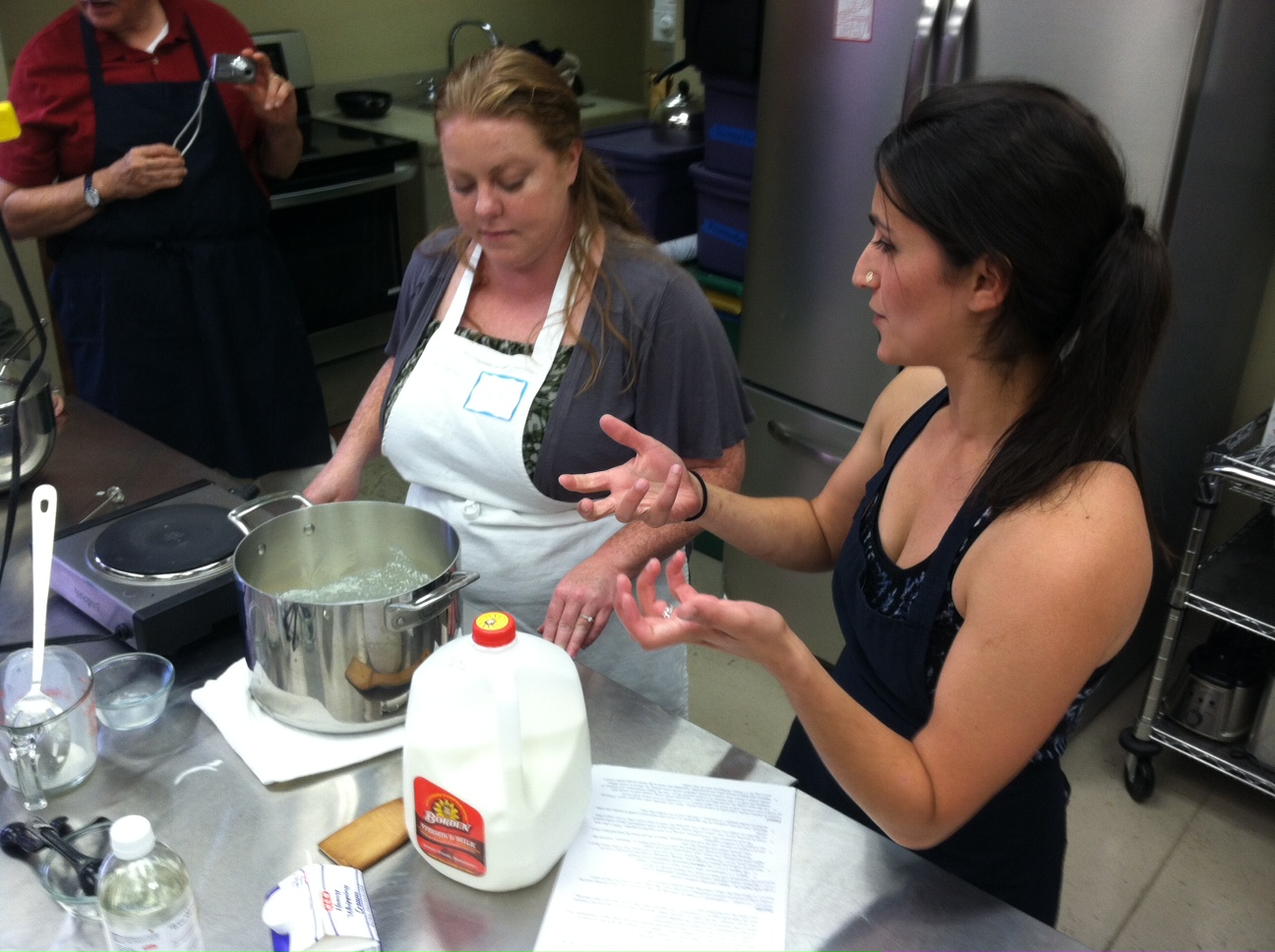
I divided the class into two groups: one made ricotta with vinegar and the other made ricotta with lemon juice. While they were working over their pots, I talked about making ricotta with buttermilk and with the microwave shortcut, both of which I think are unreliable and open up a world of wasted milk. After we strained the two batches of ricotta and compared the differences, we made one more batch with vinegar to press into paneer.

I tried to keep all science information quarantined to nuggets specifically related to the category of fresh acid-coagulated cheeses we were making. For instance, after the broad overview, we skipped entirely over starter cultures and rennet in favor of more detail on proteins and fat, the main players in heat and acid-precipitated cheeses like whole milk ricotta.

The students were wonderful and very interested in the science, or at the very least indulged my belief that the science was important. All the cheeses turned out. Best of all, I had fun. I really enjoyed teaching the variations on each recipe and constantly reminding them that cheesemaking is a big science experiment that allows them to figure out for themselves which modifications and techniques will actually work for them.

As the series continues, we'll build on the science and I'll indoctrinate my students with all the necessary curd nerdiness, thereby totally validating my need to know exactly how everything works.

Spring Renewal

In dreaded anticipation of the dawn of my personal hell -- summer in Del Rio's 100+ degree heat -- I'm sucking the life out of one of our last few temperate days. (I know those of you still covered in snow and ice hate me right now.). I'll be spending the next hour on my stoop eating some homemade ricotta, honey, and berries, swatting bees away like a madwoman.

After a month of intense yardwork at the new house, recovering from a recklessly bad case of poison ivy, traveling for friends' special occasions, and the futile search for a day-job in the sad state of affairs Del Rio calls a local "economy," this little homemade ricotta snack is my detox. I'm wiping the slate clean and renewing my goals and objectives in time for spring.

This ricotta is from a test batch, and only the second batch of cheese since moving into the new house. Yes, I'm ashamed.  I made it in anticipation of my first cheesemaking class at the local arts center in a week. I made a couple varieties with different acid coagulants (lemon juice, vinegar, buttermilk) and with different ratios of added cream (from one cup to zero), to find the consistency appropriate for a given culinary purpose. Berries and honey, in case you were wondering, demand a 4:1cup milk to cream ratio with either a vinegar or citric coagulant. Okay, okay, it's less of a test batch and more of a proving-to-myself-that-I-still-enjoy-it batch.

Boy WILL I ever enjoy it....Tad's still at work, so this batch and this bottle is all for me. Boom! Happy Friday!


Straight Outta Comte

On Valentine's Day last year, I was earning my bones working one of the busiest days I had seen at any retail store much less a cheese shop. I recounted in last year's post how an unyielding 6 hours of cheeses sales was my sink-or-swim introduction to real cheesemongering. Since leaving the retail cheese world, there have been a lot of weird tasks and rituals that my muscle memory misses.

Pulling the cling wrap tightly around an oddly shaped wedge to create a perfect wrinkle-and-bubble-free display for the case (I imagine the cheese thinking it's getting tightly tucked into bed). Creating the perfect crisp folds in the butcher paper to neatly wrap a purchased slice like a Christmas present. Wielding a giant knife cleanly and straightly down a firm aged wheel with the weight of your whole body to cut a (nearly) perfect quarter-pound. Tasting the first nibble from a freshly cut wheel, the insides of which haven't seen the light of day in months or years, yet which nature intended to go directly into the darkness of my belly after their first seconds of freedom. Processing the first waft of controlled dairy spoilage that hits you when opening a refrigerator filled to the brim with cheese.

Even then I knew this year would be much...quieter, but equally exciting. While I might not have many delicious cheeses to spend my evening with, I'd have my real life human forever-Valentine. I was wrong. I got to have both.

Thanks to...
THIS:

And THIS: 


I had ALL this cheese in my fridge because of some very special friends I'm lucky to have made over the last three cheese-filled years. An entire shelf stuffed with cheese from Cato Corner, Black Sheep Creamery, and Bedford Cheese Shop. A package at my doorstep with whole wheels set aside from larger batches especially for me. Another shipment containing a curated-with-love selection of four delicious slices of domestic and European cheeses I could never find within 1,000 miles of here. A whole loaf that someone (maybe everyone) remembered was my most favorite bread ever (Amy's Bakery Potato Onion Rye), which I would always poach to take home at the end of the night's wastage.

That's love.

Once again, I could wield giant knives to cut open wheels and taste the first slice. I could trace back the creases a friend had used to meticulously fold a wedge of cheese. I could pull that saran wrap tightly around the remaining portion of bread. I could let my tastebuds have their very own Valentine's day, romancing an amazing piece of three-year-old raw milk Comte that I'd be hard pressed to find again for a long while. Best of all, my fridge smells like cheese -- and love -- when I open it.

The Dream Crusher

For those who know the comfort and profitability of an office job, who fantasize about how following your unconventional dreams would be a world replete with gumdrops, unicorns and self-satisfaction, this is the post that will kill those dreams. Sorry.

You might have noticed (if you still check this page) a significant period of radio silence from me since I left New York, got married, and moved back long-term to the borderlands of desert and brush. That's because I seriously have nothing to tell you.

Del Rio was an adventure when I first came here in 2010 after a year of cheesemaking and on the tail-end of an epic road trip. That was before I left for a year of cheesemongering in New York. On my return, the Rio Grande desert has lost a substantial amount of luster. I won't pretend like the sentiment contained in the preceding two sentences is anything but completely pretentious and fully cliched: Itinerant Midwestern girl moves to the big city with bright lights and everything else seems a little more dull and far less cosmopolitan on her return. Yeah I sound like a jackass. I know.

I guess you could call it the
 best most awful thing 
But it's the truth. After all, isn't ambition as much pretension as it is courage? Doesn't it contain an equal part of narcissism as it does creativity? If you wanted something really bad and find yourself in a dead end, doesn't all that selfishness sour into a fermented pot of self-pity and existential questioning? I had a life in New York. I had friends, new and old. I had a job with money for rent and fun. I had activities and exploration at my fingertips. I had a gym and amazing surroundings when things got stressful. I had food options when things got hungry. I was learning and bettering myself. I had a sense of purpose. I had cheese! Now I find myself without any of those things.

I've seen some places in my day and knew how Del Rio compared to most other big cities and small towns long before I moved to New York. So perhaps my cheerier outlook during my 2010 stint here was due to other factors. Maybe my two-day cheesemaking gig in Waco distracted me (an 11-hour commute I refuse to do again for safety, monetary and sanity reasons). Or maybe it was because I knew my stay would be much more temporary that time. Maybe I will feel better now if we had a house with a real kitchen for home cheesemaking and teaching cheesemaking classes, or a yard for some goats.

This image, my friends, is what the literati like to call
Juxtaposition
In any event, the transition of going from a whole lot of something to a whole lot of nothing has been, in a word, lame. I find myself rage-eating an entire tub of wine-infused cheese spread (glorified Easy Cheese) from a Holiday basket. Or standing over the sink while I devour a tub of pre-crumbled blue cheese that tastes like plastic. Just to get a fix.

But the worst part is the self-doubt. The wondering if my original plan was really such a genius idea. I've already realized in the last year that opening a retail store-front would force me back into the office doing administrative nonsense. And have I told you how much I freaking hate paperwork? But is cheesemaking much better for me? Sure it's more hands-on work, but I'm also a social creature. Would I really enjoy working completely alone over a pot or vat of cheese all day? Or did I love it so much ONLY because of the people I was able to work with and befriend?  I have met with a few goat breeders in the area, but do I really know how to handle an animal? My only pet in life has been a goldfish.

I have no idea what 2013 will have in store for me life-wise or cheese-wise. All I know, is that Jay-Z is full of crap. It is wholly false that making it in New York means you can make it anywhere. I'd like to see him try to start his career here. Jerk.

A Dairytale Honeymoon

On the first day of a honeymoon on a tropical island, most people do romantic crap like gaze into each others' eyes and hold hands on the beach. I asked my newlywed spouse to drive a rental car through treacherous Puerto Rican election-week traffic to a small town an hour outside of San Juan to visit the island's only artisanal cheesemaking facility. It's cool. He knew what he was getting into with me.

When vetting honeymoon locations, one of the first things I did was look for a local cheesemaker to visit in the area (there are cheesemakers in both Kenya and South Africa, for those interested). I defend this as a completely justifiable occasion for a cheese adventure. After all, as I've noted before, cheese is a known aphrodisiac.

I discovered Quesos Vaca Negra while perusing through Culture Magazine many months ago while we were still in honeymoon discussions. So, when we decided on a Caribbean destination with a two-day layover in Puerto Rico, the first thing I did before booking anything was contact the ladies in charge of the cheese operation at QVN and beg them to let me visit.  Rosa and Wanda graciously obliged. 

We dragged ourselves out of our comfortable hotel room early that first morning, hopped in our rental car and navigated ourselves through a rural area just outside of Arecibo, Puerto Rico. In a converted house, we found an immaculate cheesemaking room, aging facility, milk-quality testing lab, and Rosa, our kind host for the morning.

Since their start as full-time cheesemakers about four years ago, the ladies of Quesos Vaca Negra have become local celebrities and the only destination for quality aged raw milk cheeses in Puerto Rico. The operation started off as a milk testing lab that helped local dairy farmers determine their milk quality. Soon, Rosa and Wanda began dabbling in some home cheesemaking with the milk that their farmer-clients supplied in trade for lab tests. These two bold, confident, intelligent ladies decided to turn it into something more; something that the Puerto Rican market lacked, yet craved. Four years later they are getting big-time attention from the North American cheese market, and at least one over-eager cheese girl from Texas pounding on their doors to make a new cheese friend.

They have about a half dozen cheeses in their repertoire, ranging from Gruyere-style to Cheddar, and the occasional experiment with adding spices, herbs, and flavors to some of their standards. Their cheeses appear on the Puerto Rican market in local grocery stores as well as through their farmers market presence in Old San Juan.

Student cheese in the brine
from a recent class
They also hold cheesemaking classes for local cheese-o-philes. In most cheesemaking classes that I've seen, you pay a solid Benjamin to get a twenty minute lecture on cultures, rennet, and dairy science, stretch some mozzarella, stir some vinegar into warm milk (Bam! Ricotta.), and peace out with your standard homemade concoctions. These ladies, on the other hand, do it right. At the end of their class, each participant has a full wheel of raw milk cheese that will be aged for them at the QVN facility for two months. The students can bring their own spices to set their cheese apart from their classmates' creations. After the cheese has aged, they come back and pick up their handmade dairy delight. It's a lot more post-event effort on the teachers' end, but that's a cheesemaking class worth dropping some cheddar on.

All of QVN'a milk comes from various local dairy farmers on the island. Each cheese is named after the local region from which its milk originates. The milk travels from the farms to the QVN facility in a giant dairy tank that they welded to the back of a standard size pick up truck. One glance at their makeshift dairy muscle truck solidified Rosa and Wanda's position in my cannon of dairy heroes.

In Old San Juan, Rosa owns another slice of heaven -- a bright pink waterfront townhome in the colorful architectural style of the neighborhood. She hopes to turn it into a cheese and charcuterie shop. It would be the first of its kind in that area for locals and tourists alike. If it were open for our visit, it would have been the ideal spot to get some honeymoon picnic provisions. Every town needs the perfect cheese shop.

During our two-hour visit, we toured their facility, talked cheese, ate cheese. And like the cheese pros who helped them get on their feet, Rosa, now a certifiable pro herself, gave me advice and the offer of future troubleshooting help in getting started with my own cheesemaking operation.

I had the singular experience of making a cheese friend on vacation. On my honeymoon, no less. And with all the goodwill Tad had earned for taking me out there and stuffing his face with cheese, there was still plenty of time left over for all the romantic crap too.


With this Cheese, I Thee Wed

After a self-imposed hiatus from Cheesy Street to take care of a little business, namely getting married, I'm back. This serves as a brief but much needed reminder -- mostly for myself -- that the cheese dream is alive and well.

This isn't a wedding blog so I'll keep the recap brief: the wedding weekend was more fun than I could have hoped; it was an unforgettable way to begin a life with my biggest fan who has encouraged me through pounds of cheese dreams; and it made me wish I could round up all the beautiful people we have been given in our lives and force them to live closer to me. Oh and we had a cheese sculpture.

Actually we served a lot of cheese. Thanks to the three farms where I started off making cheese, I was able to curate a legit cheese plate. None of my cheese heroes were able to make it to the big day, but they were more than represented in spirit with the cheeses they sent me. It warmed my guests' bellies and it warmed my heart to know that I'd worked with such amazing, supportive people. There was a soft, bloomy offering with the raw milk brie and fig leaf-wrapped Eden from Brazos Valley Cheese. We had the firm, nutty sheep's milk Queso de Oveja from Black Sheep Creamery. And for the adventurous guests there was the soft, pungent Hooligan from Cato Corner. Along with the cheeses I threw out some staple accompaniments like mustard, fig jam, dried pears, and candied nuts.

There was also the safe option of mild Wisconsin cheddar cubes, which was no less awe-inspiring because it came from a cheese sculpture representing our KS+TX theme by depicting Tad's alma mater with a Texas Longhorn mascot marrying my beloved KU Jayhawk mascot (in a more feminine rendition). It was, in a word, badass. The sculpture was carved and shipped by the sweet and talented, Sarah Kaufmann, who is currently a Guinness World Record holder as sculptor of the largest cheese carving ever. Plus, we're basically best friends forever now. She doesn't know it yet.

My homies at Bedford Cheese Shop were also represented with the cheese wall I made with cheese label art I collected while I was there. It might attract its fair share of flies, but this thing is getting hung up on proud display when we get a new house.

There was almost no cheese leftover at the end of the night. Guests of varying cheese experience and comfort levels devoured it all. Seeing how much everyone enjoyed and talked about the cheese drove home the point that you can really get crazy with the cheeses you cater to big events. It doesn't have to be boring to please everyone. If it's a diverse group of people, a diverse array of cheeses will have something for everyone.

Now, I'm back in the heart of West Texas, trying to set up my own cheese world. First my plan involves contacting goat cheese makers and goat breeders in the area, which I've already started doing (updates on that shortly). Then...we'll see. For now, it's good to be back!